April 23, 2010
Renewable Energy Federal Grant Schedule Changes
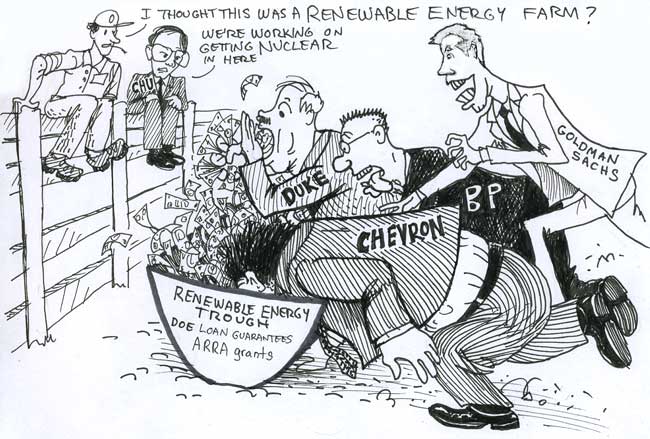
A change in the American Recovery and Reinvestment Act (ARRA) grant requirements has occurred. This grant would cover 30% of construction costs to qualifying Fast-Tracked solar and wind projects.
Orginially to qualify, projects had to break ground by December 31, 2010 and spend at least five percent of the total project cost in 2010.
However, First Solar reported to a group of environmentalists that the United States Treasury issued new guidelines at the end of last month. Now, developers have the flexibility to begin construction by Decmber 31, 2010 either on-site OR off-site by beginning manufacturing of panels or other associated equipment intended for the specific project site. Companies will take on some risk by starting manufacturing off-site before they have their permits in hand, but many companies, like First Solar, will be willing to take this on.
Developers do not need to receive their permits by the end of this year, which gives more flexibility to the permitting schedule. However, in order to meet the Department of Energy loan guarantee, they will need their permits by September 2011. We may see other projects begin to change their permitting schedules with the relevant agencies.
April 2, 2010
San Diego Runs Out of Power Due to Grid Failure
Distributed Generation is not just better for the environment, the economy, and local communites, it improves the reliability of the grid as a whole.
A shortage of power from the transmission grid forced San Diego Gas & Electric to shut off power for 45 minutes to one-fifth of its customers (291,000 accounts, nearly a million people). Not enough power was being generated in San Diego County to ensure the electric system was stable.
A California Independent System Operator spokesman was unable to explain what happened except in the broadest terms: Not enough power was being produced locally, so usage had to be cut to avoid bigger problems. “If you rely solely on the transmission grid and something happens to the transmission grid, you don’t have any alternatives,” spokesman Gregg Fishman said.
San Diego almost ran out of electricity early yesterday, and only a massive, intentional outage that left one of every five homes and businesses without power prevented instability that could have led to an uncontrolled West Coast blackout.
The ISO, which runs the state grid, ordered the outage. The ISO is responsible for making sure the amount of electricity generated exactly matches the amount used. An imbalance could trigger a series of uncontrolled blackouts, taking down power plants.
The order came minutes after one of the county’s biggest plants, in Otay Mesa, went offline, reducing the local power supply by 600 megawatts at the same time that two other big plants, in Escondido and Chula Vista, were down for maintenance.
The utility is responsible for ensuring that it makes or buys enough power to meet the needs of its customers, but the ISO decides when particular plants run.
For the grid operators, power generation isn’t just about how much is available but where it’s being delivered, so some power must be made locally. While the ratio of imported to local generation depends on a variety of factors including weather and electricity demand, the ISO wants at least 25 percent of the region’s power to be generated locally.
Michael Shames, executive director of UCAN, the Utility Consumers’ Action Network, was shocked at the outage. “One big question: How could they not have enough local generation?” Shames asked. “We have a case here of either major human error or a catastrophic failure of the state’s transmission system. All signs, at the moment, point to jaw-dropping human error.”
Story in San Diego Union-Tribune.
March 5, 2010
Sage Grouse Listing Warranted But "Precluded"
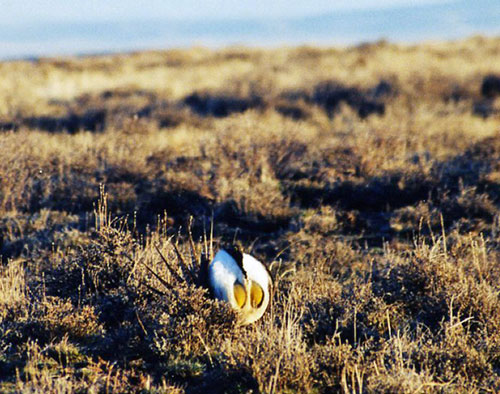
In response to a petition and lawsuit from various environmental and other groups the U.S. Fish and Wildlife Service announced Friday that the Greater sage grouse (Centrocercus urophasianus) warrants protection under the Endangered Species Act, but that such protection is precluded due to lack of resources. In other words, a backlog of species exists, and Interior Secretary Ken Salazar (a past corporate lawyer) would rather increase staffing for new Renwable Energy Coordination offices across the West than hire more Fish and Wildlife Service Personnel.
This opens the way for continued development of wind energy (for example see our story on Spring Valley Wind in eastern Nevada, surrounded by active leks), and oil and gas leases. Salazar said in a news release that other species that are in greater danger.
The Department of the Interior has a new purpose lately, "Our Mission: Protecting America’s Great Outdoors and Powering Our Future" (www.doi.gov).
Secretary Salazar said: "The sage-grouse’s decline reflects the extent to which open land in the West has been developed in the last century. This development has provided important benefits, but we must find common-sense ways of protecting, restoring, and reconnecting the Western lands that are most important to the species’ survival while responsibly developing much-needed energy resources. Voluntary conservation agreements, federal financial and technical assistance and other partnership incentives can play a key role in this effort."
The Greater sage-grouse population, which includes most of the range of the species, will be placed on the candidate list for future action, meaning the species would not receive statutory protection under the ESA and states would continue to be responsible for managing the bird.
The sage grouse finding results from a lawsuit filed in 2006 by an Idaho
group, Western Watersheds Project. A federal judge in Boise, Idaho, ruled in
2007 that political pressure tainted an earlier decision not to list the
sage grouse.
Bureau of Land Management Director Bob Abbey, whose agency manages more greater sage-grouse habitat than any other government agency, said that the BLM will today issue guidance that will expand the use of new science and mapping technologies to improve land-use planning and develop additional measures to conserve sage-grouse habitat while ensuring that energy production, recreational access and other uses of federal lands continue as appropriate. The BLM guidance also addresses a related species, the Gunnison sage-grouse (Centrocercus minimus), which has a more limited range, and which is in the process of being evaluated by the U.S. Fish and Wildlife Service to determine whether it also warrants protection under the Endangered Species Act.
Center for Biological Diversity had petioned the Mono Basin sage grouse as well, a genetically unique population in eastern California and western Nevada. This too was warranted but precluded.
“Delaying protection for Mono Basin sage grouse is clearly illegal and irresponsible,” said Rob Mrowka, an ecologist at the Center in Nevada.
Center notes: "During his eight-year tenure, Bush protected a mere 62 species, for a rate of fewer than eight species per year. This compares to 522 protected under Clinton, or 65 species per year, and 231 species protected under George H.W. Bush, or 58 species per year. With only two species listed so far, the Obama administration appears to have flatlined on listing. Under the Endangered Species Act, the Fish and Wildlife Service can only delay protection of species if it is making expeditious progress listing other species considered a higher priority for listing."
U.S. Fish and Wildlife Service page on Sage grouse.
Associated Press through Yahoo News >>here.
Center for Biological Diversity >>here.
Western Watersheds Project >>here.
Padilla Bill Updates
UPDATE: March 22, 2010 - Governor Schwarzenneger and Interior Secretery Salazar met today at Harper Lake, San Bernardino County, today in a ceremony to sign SB 34 into law. Harper Lake is the site of pre-existing SEGS VIII and IX parabolic trough plants, inaugurated in 1989 and 1990 respectively, by LUZ, before it went bankrupt in 1991. The plants are now owned by NextEra.
In addition a new proposed parabolic trough plant that would be much larger, the 250 MW Abengoa Mojave Solar project, is trying to get permitted for the area. It would be wet-cooled. The owners of the pre-existing adjacent SEGS plants have intervened in the California Energy Commission proceeding for the certification review of the Abengoa proposal. Harper Lake Basin is in such bad shape for groundwater resources that it is in adjudication. Beyond critical overdraft, water pumping is now controlled by a Water Master, who fines users for going over set limits. Water is also brought in. Where Abengoa will find its water is a thorny issue.
March 12, 2010 - Padilla Bill Passes. Should be signed into law soon. See bill >>here. "In order to enable certain solar powerplant owners and developers to remain eligible for funding pursuant to the federal American Recovery and Reinvestment Act of 2009, it is necessary that this act take effect immediately."
March 2, 2010 - A February 5 version of the California state bill that would help expedite solar energy came out (see below). Photovoltaic plants have been added to solar thermal power plants in the new plan, that melds with the Desert Renewable Energy Conservation Plan being developed by California Department of Fish and Game (DFG).
The bill proposes to establish a Renewable Energy Resources Development Fee Trust Fund, that would be loaned $10 million dollars from a Renewable Resources Trust Fund so that DFG can begin purchasing mitigation land for such species as the desert tortoise before solar companies even pay into the fund with fees.
Only companies that have there application in to the California Energy Commission (for solar thermal power plants) or to DFG ( for utility-scale photovoltaic projects) by February 1, 2010 would qualify, and they must also qualify for either DOE loan guarantee or an American Recovery and Reinvestment Act of 2009 grant.
The revised bill SB 34.
February 23, 2010
Padilla Bill Passes California Senate: Expediting Solar Thermal Projects
SACRAMENTO, California -- Senator Alex Padilla (D-20th district) introduced a bill that would help the overloaded California Energy Commission speed up permits for 11 large renewable energy projects to help draw more federal stimulus money. The bill lets developers of the solar thermal power plants pay the commission's costs of hiring independent consultants to review proposals. The projects are in Fresno, Imperial, Kern, Riverside and San Bernardino counties. The bill by Padilla, a Democrat from Los Angeles, was approved on a 33-0 vote Monday. It now goes to the Assembly.
Summary of the bill: SBX8 34 (Padilla)
(1) Existing law vests exclusive power to certify a thermal powerplant with the State Energy Resources Conservation and Development Commission (Energy Commission). Existing law requires a person to obtain a certification from the commission prior to
commencing the construction of a thermal powerplant. This bill would require the Energy Commission to establish a process for certain applicants for certification of a solar thermal powerplant that allows the applicant to elect to pay additional fees to be used by the Energy Commission to contract with 3rd parties to assist Energy Commission staff in performing the analysis otherwise performed by staff in determining whether or not to issue a certification. The Energy Commission would retain discretion as to when this option will be offered to qualified applicants.
Basin and Range Watch comment: Would these third party consultants be publicly vetted? Would they be biased or objective? Would they be the same consultants hired by the applicants?
(2) The California Endangered Species Act (CESA) requires the Fish and Game Commission to establish a list of endangered species and a list of threatened species and requires the Department of Fish and Game to recommend, and the commission to adopt, criteria for determining if a species is endangered or threatened. CESA states that state agencies should not approve projects, as defined, that would jeopardize the continued existence of any endangered species or threatened species or result in the destruction or adverse modification of habitat essential to the continued existence of the species if there are reasonable and prudent alternatives available consistent with conserving the species or its habitat that would prevent jeopardy. CESA further declares that in the event specific economic, social, or other conditions make infeasible these alternatives, individual projects may be approved if appropriate mitigation and enhancement measures are provided.
This bill would require the department, in consultation with the Energy Commission, to develop and implement an interim strategy for mitigation measures pursuant to CESA for the construction of certain solar thermal powerplants. The bill would condition this
requirement upon a developer or owner of a proposed solar thermal powerplant agreeing to reimburse the department and the Energy Commission for all state costs associated with the development and implementation of the interim strategy. The bill would establish the Renewable Energy Resources Development Mitigation Trust Fund as a continuously appropriated fund in the State Treasury to serve, and be managed, as an optional, voluntary method for developers or owners of solar thermal powerplant projects, as defined, to deposit fees sufficient to complete mitigation and enhancement measures pursuant to the interim strategy adopted by the department and thereby meet their requirements pursuant to CESA. The bill would require that the fund be managed by the
California Wildlife Foundation or the National Fish and Wildlife Foundation as determined, and subject to oversight, by the department and would prohibit any expenditure from being made from the fund except as authorized by the department.
Basin and Range Watch Comments: Some of the applicants must have taken Senator Padilla to dinner, and he gave them everything they want. With this plan, the applicants just pay a modest fee and let the public and concerned groups, as well as the Department of Fish and Game, shoulder the responsibility for finding mitigation lands for desert tortoises, figuring out all the details. This is a setback for protected species.
From AroundTheCapitol.com, and BusinessWeek.com.
February 19, 2010
Oregon Looking at Feed-In Tariff Like Germany
Big corporations get generous subsidies for utility-scale solar power plants, why not home-owners and small bsinesses?
Story in OregonLive.com >>here.
February 10, 2010
New Giant Renewable Energy Zone on East Mesa/Chocolate Mountains Proposed by BLM
We are attemtopint to talk to Bureau of Land Management concerning the purpose and need for this new 21,300 acre energy zone on East Mesa in Imperial County, California, which is habitat for several rare species and a popular recreation area. So far BLM has been quiet about this to us. The area is apparently a geothermal hotspot, with the potential tp produce more than 600 MW, which could be used by the Chocolate Mountains Aerial Gunnery Range. This is part of a push to switch military bases to renewable energy (see IEEE Spectrum >>here).
Release Date: 02/10/10
Contacts: Stephen Razo, 951-697-5217, srazo@ca.blm.gov
News Release No. CA-CDD-10-33
BLM Initiates Environmental Review of Proposed West Chocolate Mountains Renewable Energy Project
The Bureau of Land Management (BLM) today published a notice of intent (NOI) to conduct an environmental review on a proposal to consider renewable energy development, including geothermal, solar, and wind, on public lands within the West Chocolate Mountains area, near the Salton Sea in Imperial County, east of Niland and northeast of El Centro, California.
The proposed project areas covers approximately 21,300 acres of BLM-managed public lands bordered by the Imperial/Riverside County line on the north, the Chocolate Mountains Aerial Bombing and Gunnery Range on the east, the Imperial Sand Dunes Recreation Area on the south and the Imperial Valley agricultural belt on the west.
Publication of the NOI initiates a public scoping period of 30 days, ending March 12, 2010. During the scoping period, the BLM solicits public comment on issues, concerns, potential impacts, alternatives, and mitigation measures that should be considered in the analysis of the proposed action. The date(s) and location(s) of any scoping meetings will be announced at least 15 days in advance through local media and the BLM Website at: http://www.blm.gov/ca/st/en/fo/cdd.html. In order to be considered in the draft environmental impact statement (EIS), all comments must be received prior to the close of the scoping period or 15 days after the last public meeting, whichever is later. We will provide additional opportunities for public participation upon publication of the draft EIS.
The principal issues identified thus far include hydrology; Native American concerns; cumulative impacts of other existing or proposed energy projects in the area; and potential impacts on cultural resources, wildlife, recreation and visual resources. The draft EIS will also address issues such as geology, geothermal resources, vegetation, threatened or endangered species, air quality, noise, transportation, human health and safety, and socioeconomics, as well as any additional issues raised by the public during the scoping process.
Public comments received will be used in the development of a draft EIS in compliance with the National Environmental Policy Act. Written comments should be submitted to the BLM's California Desert District Office, Attn: John Dalton, Chocolate Mountains Geothermal Leasing Coordinator, 22835 Calle San Juan De Los Lagos, Moreno Valley, California 92553.
For more information contact John Dalton at (951) 697-5311 or e-mail John_Dalton@ca.blm.gov, or Daniel Steward, BLM El Centro Field Office branch chief (760) 337-4400 or e-mail Daniel_Steward@ca.blm.gov.
BLM California Desert District website >>here.
January 29, 2010
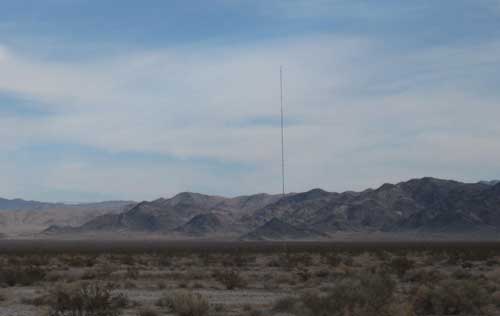
<Meterological tower on desert flat near the Silurian Hills, San Bernardino County north of Baker and southeast of Death Valley National Park. Wind companies use these met towers to test winds for future wind farms.
Wind and Solar Proposals Next To Kingston Range Wilderness
Driving south through Baker yesterday we noticed two new MET towers covering a large area. Pacific Wind Development LLC wants 6,623 acres of Bureau of Land Manegement desert near the Silurian Hills, directly adjacent to Kingston Wash in the Kingston Range Wilderness.
Kingston Range Wilderness is 209,608 acres, rising to 7,323 feet. Rugged dolomite crags with pinyon-juniper and white fir forest loom over Joshua tree forest and an isoalted stand of Nolinas. Bighorn sheep and Gila monsters are found in these mountains, and the Amargosa River flows through the northwestern section.
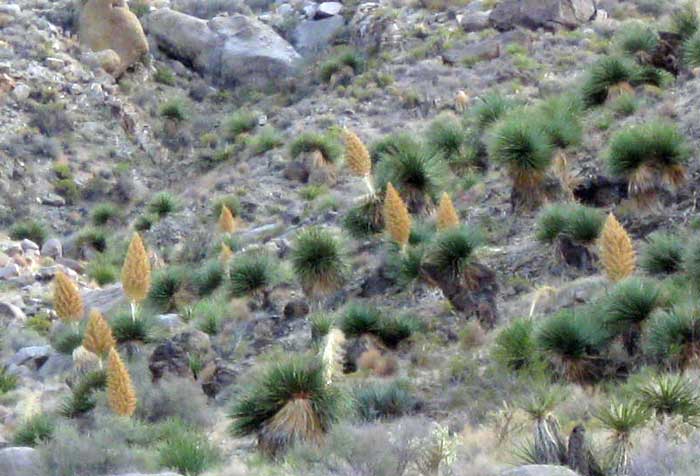
^Parry nolinas (Nolina parryi) on slopes of the Kingston Range. This is an isolated population; most live in the Joshua Tree National Park region.
At this point, the entire desert seems claimed. If you are somewhere in the California Desert, you don't really have to wonder IF the view your looking at has wind and solar applications on it. Now it is a matter of which application you are looking at. At this point, most of the wilderness areas would just end up being islands of broken habitat surrounded by endless renewable energy sprawl under their best case scenario.
There are also two concentrated solar power plant proposals for the area and applications for solar thermal all the way up to the BLM Salt Creek Area of Critical Environmental Concern (south of Dumont Dunes):
BLM Barstow Field Office: Solar Investments, Inc. as of 1/18/07 wanted a 1,000 MW solar thermal project on 10,611 acres in Silurian Valley. But due to a switch to photovoltaic technology (probably because of a lack of water), a new Plan of Development is pending.
BLM Barstow Field Office: Solar Investments VI LLC as of 1/18/07 wants 8,384 acres for 800 MW of solar thermal by Baker. The Plan of Development is under revision as of 01/09.
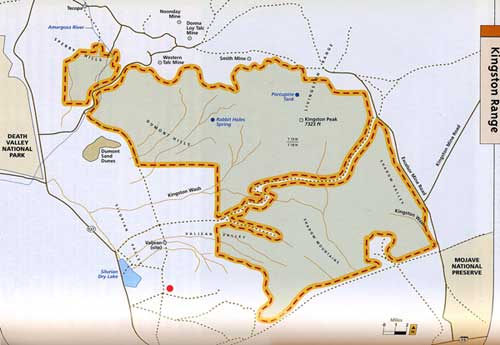
^Kingston Range Wilderness. Red dot is the approximate location of one of the met towers now present.
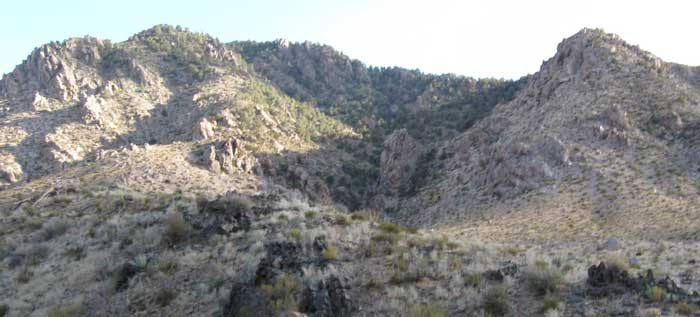
^Kingston Range.
January 28, 2010
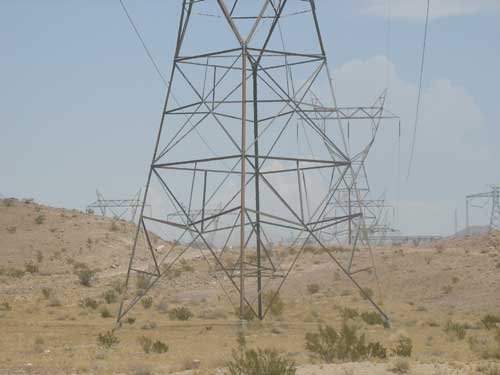
Salazar: Fast-Tracking Transmission Lines
Not bothering to talk about any other issues such as species protection, or recreation issues, Interior Secretary Ken Salazar issued a statement.
"For the first time ever, the Department of the Interior is exploring our deserts and plains for their vast clean energy potential. As a Department which oversees 20 percent of the nation’s lands we have huge solar potential; the public lands in the deserts of the Southwest near the great cities of Los Angeles, Las Vegas, and Phoenix contain an estimated 2,300 gigawatts of energy."
"We are redoubling our efforts to evaluate and approve existing applications for solar energy projects. The BLM is currently processing approximately 128 applications for utility-scale solar projects that involve around 77,000 megawatts and 1.2 million acres of public land."
"Solar and other renewable energy resources are often located in remote areas, and will require new transmission capacity to bring this clean energy to population centers. The Department has already identified and designated more than 5,000 miles of transmission corridors on federal lands. We are processing more than 30 applications for major transmission corridor right-of-ways, with 7 applications in Idaho, California and Nevada that could potentially “fast track” the permitting of over 1,000 transmission miles this year. Moreover, nine federal agencies including the Department have signed a Memorandum of Understanding committed to coordinating the expedition of siting and permitting electric transmission projects on federal lands."
"By facilitating energy transmission, reviewing current projects, and uncovering potential new sites, last year the Department made great strides towards harnessing solar power on public lands. I am proud of our achievements, and will continue to make the creation of a secure and responsible energy future a top Department priority."
We call the department the "renewable energy extinction corporation." Desert tortoises and other sensitive species on public lands beware!
Department of Interior News >>here.
HOME.....page 1....page 2....page 3....page 4....page 6....page 7
