Filling Up Chuckwalla Valley Desert With Energy Sprawl
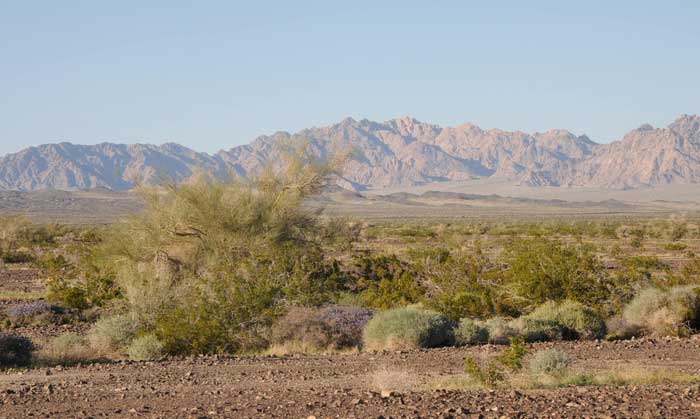
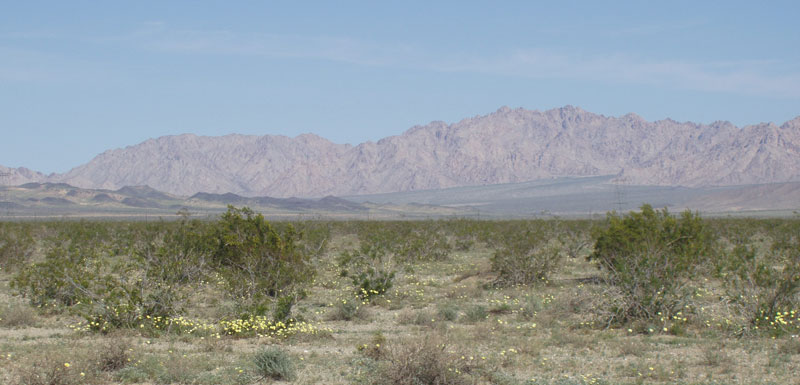
^The beautiful view in Chuckwalla Valley CA, before the bulldozers came and destroyed this scene. Desert Sunlight Solar Farm now occupies this landscape. More is to come unless we switch to smarter modern Distributed Energy Resources.
December 13, 2019 - Riverside County CA - The Field Office Reports of the California Desert Advisory Council December 2019 contain a lot of good information and news about the state of the California Desert, including off-road activity, grazing allotments, restoration activities, rare species conservation, high speed rail, and renewable energy updates.
Unfortunately, a new wave of solar project applications is descending on the Chuckwalla Valley, filling in more large-scale energy sprawl on the biodiverse desertpublic lands area in the Riverside East Solar Energy Zone. Already constructed across tens of throusands of acres of once remote and wildflower-filled desert, are Desert Sunlight Solar Farm, Desert Harvest, Genesis Solar Energy Project, and several utility-scale projects across Palo Verde Mesa near Blythe. The Palen Solar Project has been approved, but not yet under construction.
Solar Oversupply and Curtailments
This Mojave-Colorado Desert transition zone is the bullseye sacrifice zone for utility-scale solar development in the Southwest at the moment, despite the fact that current level of solar overgeneration in the desert exceeds to ability of the grid to absorb it, and therefore many large-scale solar projects such as Desert Sunlight, are regulaly "curtailed" or shut down by the California Independent System Operator.
The California Independent System Operator discusses the latest solar and wind overgeneration problem:
"The shift to a clean, efficient and modern grid is essential to California's economy and its environment. This transition to a low-carbon grid provides challenges and opportunities, as the state incorporates increasing amounts of renewable energy on to the electric system. Sometimes, during the middle of the day, California's renewable resources can generate more electricity than is needed.
"During these periods of surplus energy, the ISO's market automatically reduces the production of energy from renewable resources, or “curtail" generation. In rare instances, when economic bids from generators are insufficient, ISO operators manually curtail production to maintain the balance between supply and demand.
"While curtailment is an acceptable operational tool, as increasing amounts of renewable resources, oversupply conditions are expected to occur more often. The ISO is seeking solutions to avoid or reduce the amount of curtailment of renewable power to maximize the use of clean energy sources."
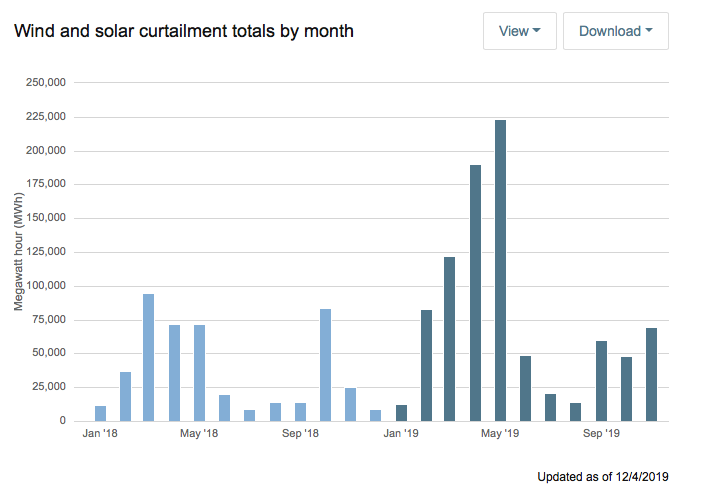
^Megawatt/hours of solar and wind projects switched off to balance the grid because of too much renewable energy at midday flooding the system. California Independent System Operator accessed December 13, 2019. It's getting worse. http://caiso.com/informed/pages/managingoversupply.aspx
The solution is advanced Distributed Energy Resources and microgrids, which can have the added benefit of reducing the need for more new fire-causing transmission lines across wildlands, and also sparing communities utility Planned Saftey Power Shutoffs. Basin and Range watch is working with the think tank Solar Done Right on a white paper about this modern smart alternative.
Wave of New Solar Projects
But without planning, more solar projects are proposed to be added into the mess.
Golden Sun Wind Project Proposed for Chuckwalla Bench
June 23, 2015 - Imperial County CA - Information obtained from the El Centro Bureau of Land Management (BLM) office indicates that the company Exelon intends to put in an application to build a wind project in the Chuckwalla Bench area of the Colorado Desert in California, a controversial location due to rare endemic Munz cholla (Opuntia munzi) and wild landscapes appreciated by desert hikers.
BLM has received a Plan of Development for a wind project on approximately 4,000 acres from the company but is delaying processing the application until after the final Desert Renewable Energy Conservation Plan comes out in winter. Desert tortoise presence-absence surveys were undertaken in spring of 2014, and 28 live tortoises were found, indicationg a total estimated population on the site of 67 adult tortoises. 11 tortoise carcasses were also found, having died during the past 1-2 years, apparently a larger die-off than in preceding years. Possibly a continuing drought in the desert and shell disease -- cutaneous dyskerotosis -- may be to blame.
Important Meeting with the Bureau of Land Management Over Resources that would Impact Joshua Tree National Park and Desert Communities
September 29, 2014 - Desert Center CA - The BLM announced scoping meetings for Eagle Mountain Land Exchange Supplemental Environmental Impact Statement (SEIS) in Riverside County, see press release explaining:
http://www.blm.gov/ca/st/en/info/newsroom/2014/september/eaglemtnscopingmtgs.html
BLM plans to go forward with giving away over 3,000 acres of mostly pristine desert canyons in the arms of Joshua Tree National Park, to a defunct mining company Kaiser Ventures, who unsuccessfully tried to construct the world's largest dump. After over two decades of successful litigation by environmentalists, that went all the way to the US Supreme Court, we say it is time to make Joshua Tree National Park whole again and return nearly 30,000 acres of land (including the defunct Kaiser mine) to the Park where it originated. WE must stop the Great Terrain Robbery being perpetrated by the BLM.
There will be two meetings to be held at BLM's Palm Springs Resource Office:
When: October 1, 2014 at 2:00 PM - 3:30 PM and another meeting at 6:00 PM - 7:30 PM.
Where: Palm Springs Resource Office: 1201 Bird Center Drive, Palm Springs.
Kaiser Gets the Mine, Joshua Tree National Park and Desert Communities Get the Shaft
STATE MINING AND GEOLOGY BOARD SCHEDULES PUBLIC HEARING TO HEAR TESTIMONY
September 8, 2014 - Background: The State Mining and Geology Board (“SMGB”) represents the State's interest in the development, utilization and conservation of mineral resources; reclamation of mined lands; development of geologic and seismic hazard information; and to provide a forum for public redress. The SMGB also conducts annual inspections, reviews and approves financial assurance cost estimates, and undertakes compliance and enforcement actions when deemed necessary. The SMGB includes in its mission statement that it will be a forum for Public redress. Further, the Board will function to “[e] nsure consistent and equitable application of the laws under the SMGB's jurisdiction.”
Based on the evidence submitted to the Fair Political Practices Commission (“FPPC”) and to SMGB, it appears that there are legitimate questions regarding the falsification of a government record, potentially designed to obscure and allow the continuation of illegal mining practices with the defunct Eagle Mountain Mine. Armed with this evidence, former SMGB members, retired Office of Reclamation employees, desert activists, environmental organizations, and community members wrote to the SMGB requesting a hearing to be held in Riverside County to take testimony on the seemingly criminal behavior occurring with the Department of Conservation, the Office of Mine Reclamation, and the County of Riverside.
The SMGB granted the Public’s request, and scheduled a Public Hearing for October 1st, in Palm Desert.
The Eagle Mountain mine, surrounded by Joshua Tree National Park, has been deemed abandoned by the DOC since 1990. In 1952 Congress granted Henry J. Kaiser the right to mine through Private Law 790 by providing rights-of-ways for a railroad, millsite, and townsite. There is an expressed condition that stipulates, in part, “…shall be subject to reversion if the rights-of-way are abandoned or not used for a continuous period of seven years…”. (Private Law 790 emphasis added)
Since 1987 various alternate uses, such as a hydroelectric pumped storage project, private prisons,military training, and the world’s largest garbage dump for Los Angeles waste, have kept it barely alive.
Pat Flanagan, a Desert Naturalist who worked tirelessly on the Eagle Mountain project is dumbfounded, “I have worked many long hours as a private citizen to prevent the Eagle Mountain Mine from being converted to a garbage dump at the edge of Joshua Tree National Monument, instead of being reincorporated into the park as it should have been long ago. The Eagle Mountain owners who wanted to do this are focused on maximizing their return on investment, and seem to care little for the park, the people, the environment, or the wildlife that will be left with the results”.
According to an August 30 story in the Los Angeles times, Mr. Thomas Ferrero is being investigated by the California Fair Political Practices Commission (the FPPC) for having interest in the Miriah Mine, a gold mine in Siskiyou County. Ferrero, in his job with the Office of Mine Reclamation has responsibility for regulating any surface mining operations at the Miriah. This would be considered a conflict of interest, which attracted the attention of the FPPC. The LA Times first reported on the conflicts, document falsification, and connections with DOC Supervisors and the Secretary of State, in an August 30 story. See http://www.latimes.com/science/la-me-adv-mining-conflict-20140831-story.html
Terry Frewin, chair of the Sierra Club’s CA/NV Desert Committee voiced his concern, “Falsifying any report is a serious matter. By allegedly doing so with a state mining report on the Eagle Mountain Mine, Ferrero has further exacerbated an issue that has had more than its share of controversy over the years.”
“Ferrero and another state mining regulator, Jason Marshall (related to James Marshall who started the game in 1848?) messing with inspection records so Riverside County's Eagle mine, which died many years ago, could appear still breathing. Where do these guys come from?”, exclaims Tom Budlong, a mechanical engineer.
Eagle Mountain Mine has served the purpose intended by Congress when it conveyed to Kaiser Steel authorization to mine iron ore in Joshua Tree National Park. Having fulfilled its purpose, it is time to make Joshua Tree National Park whole again.
“The Eagle Mountain Mine site has been steeped in controversy since the proposed dump in 1987. Community members and environmentalists successfully prosecuted the case all the way to TSCOTUS, who refused to hear the case. By Congressional law, the mine lands and the railroad right-of-way were to be returned to Public Ownership. But apparently Kaiser’s lobbyists, lawyers, and “friends in high places” are working hard behind the scenes, and laws are being violated. This needs to be exposed and corrected”, said Donna Charpied, Executive Director of the Desert Protection Society.
Contact:
Donna Charpied, Executive Director Desert Protection Society: (760) 987-1363
Pat Flanagan, Desert Naturalist: (760) 362-4156
Terry Frewin, Chair Seirra Club CA/NV Desert Committee: (805) 966-3754
Tom Budlong, Mechanical Engineer: (310) 963-1731
Desert Harvest Solar Farm
April 13, 2012 - In the Federal Register today the latest large-scale solar project was announced as beginning public environmental review. This project, slightly smaller than others in Chuckwalla Valley, will nevertheless occupy over 1200 acres of Colorado Desert habitat near the Desert Sunlight solar project (by First Solar) already under construction.
The Draft Environmental Impact Statement can be downloaded at this website:
http://www.blm.gov/ca/st/en/fo/palmsprings/Solar_Projects/Desert_Harvest_Solar_Project.html
Desert Harvest Solar Farm:
Proposed Location: Riverside County, six miles north of Desert Center.
Electricity Production Capacity: 150 megawatts.
Company: enXco.
Acreage: 1,208 acres.
Electrictrical Transmission Connection: Either via the adjacent Desert Sunlight project's 230 kV gen-tie, or the planned Red Bluff Substation.
Company's Expected Benefit:
• The project would generate enough electricity to power about 45,000 homes
• The project would have a peak construction workforce of about 300 employees
Public Comments:
Submit comments by July 13, 2012.
Publication of a Notice of Availability in today’s Federal Register initiates a 90-day public comment period for the EIS and possible plan amendment that ends July 13, 2012. During the comment period, BLM will solicit public comment on issues, concerns, potential impacts, alternatives, and mitigation measures that should be considered in writing the Final EIS that will be released later this year.
For further information please contact Lynnette Elser, project manager, (951) 697-5233, or cadesertharvest@blm.gov. Written comments may be sent to Lynnette Elser, Desert Harvest Project Manager, 22835 Calle San Juan De Los Lagos, Moreno Valley, CA 92553 or to the e-mail address provided above.
Public Meetings and Hearings:
DEIS Public Workshops will be held on May 14, 2012 at the following locations and times:
1:30 PM - 3:30 PM
Lake Tamarisk Clubhouse, 26-251 Parkview Drive, Desert Center, CA 92239
7:00 PM - 9:00 PM Joshua Tree Community Center, 6171 Sunburst Ave., Joshua Tree, CA 92252
Future meetings, hearings and any other public involvement activities will be announced at least 15 days in advance through public notices, media releases, and/or mailings.
Cumulative Impacts: enXco Desert Harvest Solar Project Announced
September 15, 2011 -- >>here.
Activists Declare Peaceful Demonstration a Huge Success
January 13, 2011 - Desert Center, Riverside County, California.
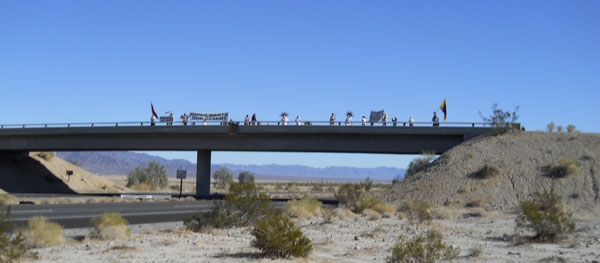
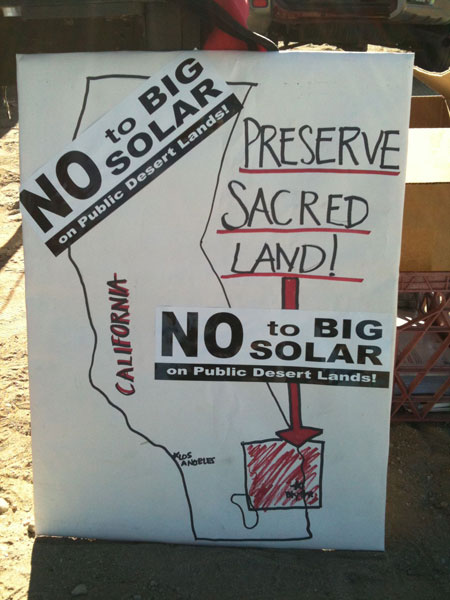
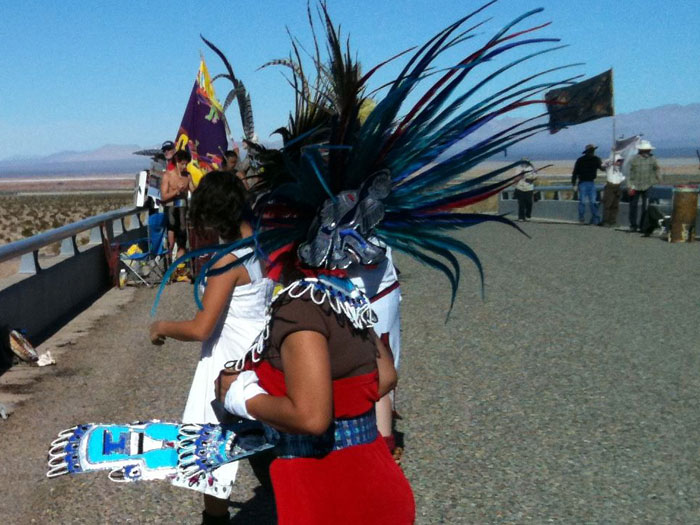
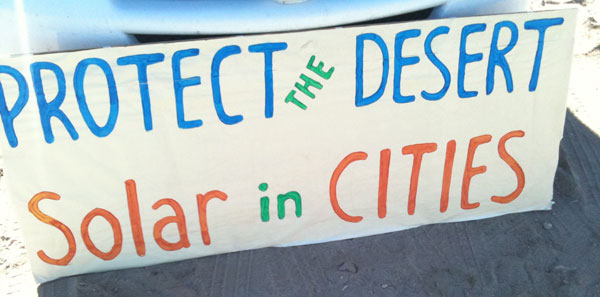
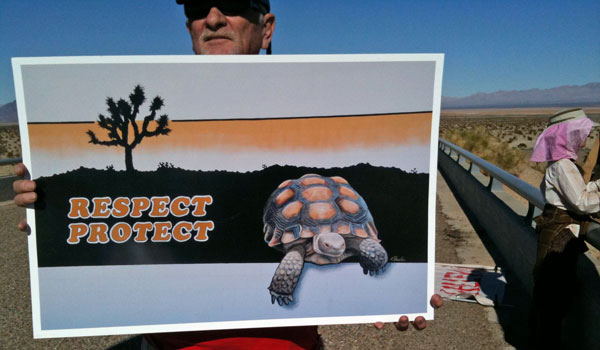
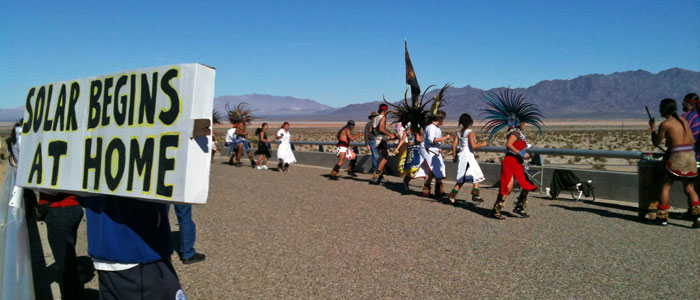
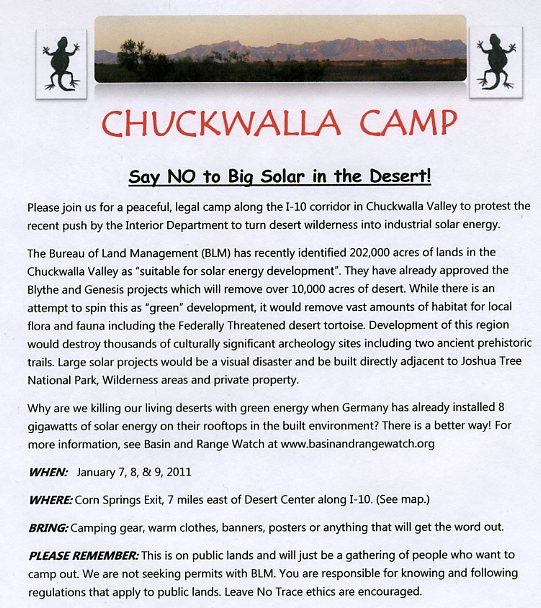
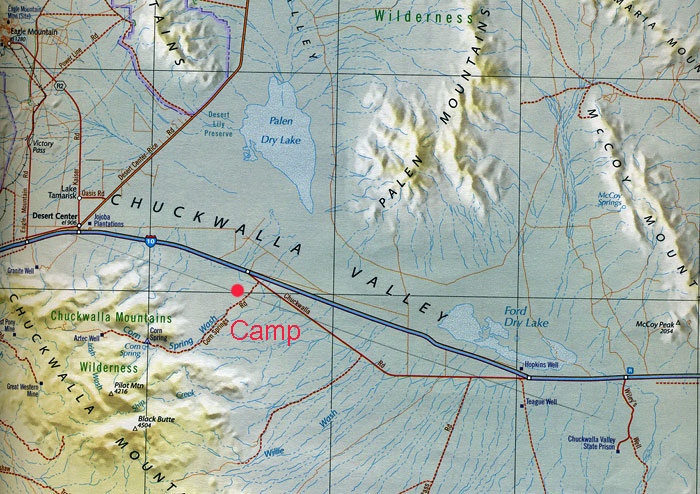
The Chuckwalla Valley is facing proposals for industrial scale solar sprawl on over 200,000 acres. This is in addition to the tens of thousands of acres that have already been approved or deep in the permitting process. To educate people and bring attention to this problem, more than 40 Native Americans, desert residents, and environmental activists came together in a show of solidarity and to highlight the concerns of transforming public lands into highly industrialized areas. The weekend Chuckwalla Valley Camp took place from Friday January 7th through Sunday January 9th. Although we were addressing a very serious issue, we sprinkled the event with entertainment. Desert warriors came from as far as Mendocino County and San Diego and were engaged in numerous activities throughout the day and evening, including peaceful protests over the Corn Springs off-ramp on I-10, Cuauhtemoc Dancers, evening music, and cultural workshops of the Aztec Calendar.
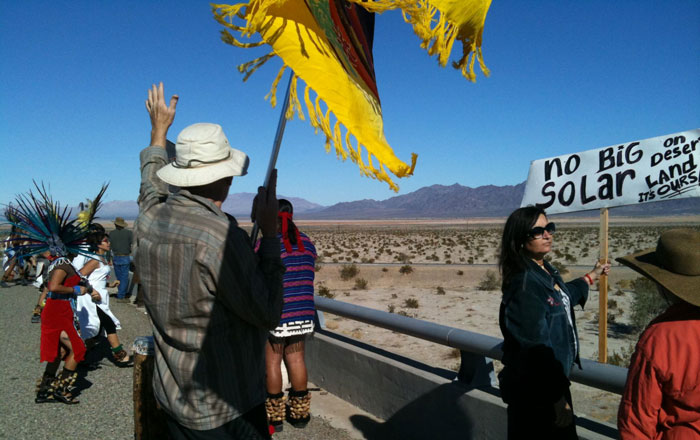
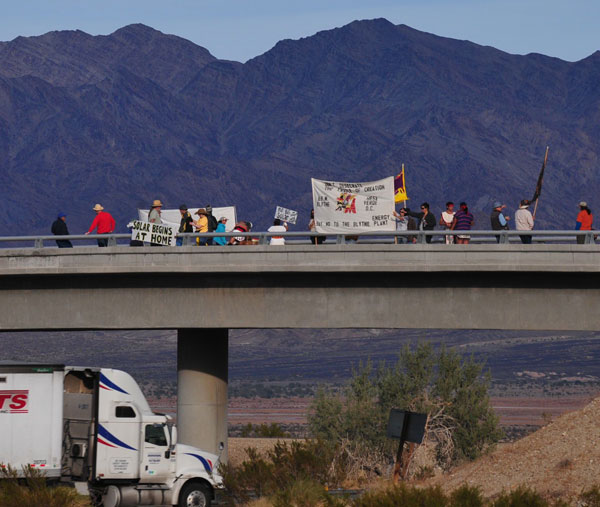
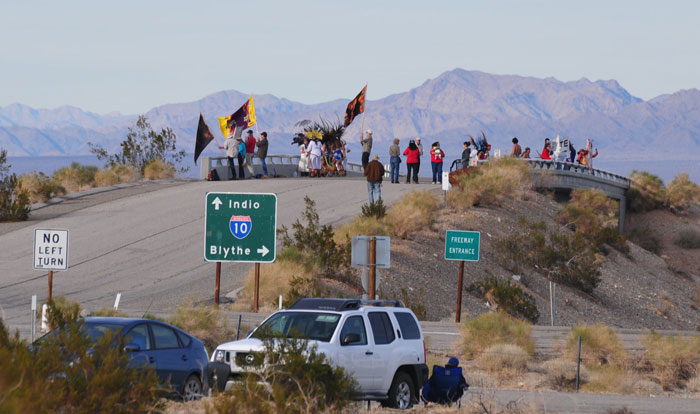
Indeed the peaceful demonstration was a huge success. With the vast backdrop of the Chuckwalla Valley, protesters marched across the over-pass holding banners, drumming, dancing, and grabbing the attention of traveling motorists who stopped at the information tent for information.
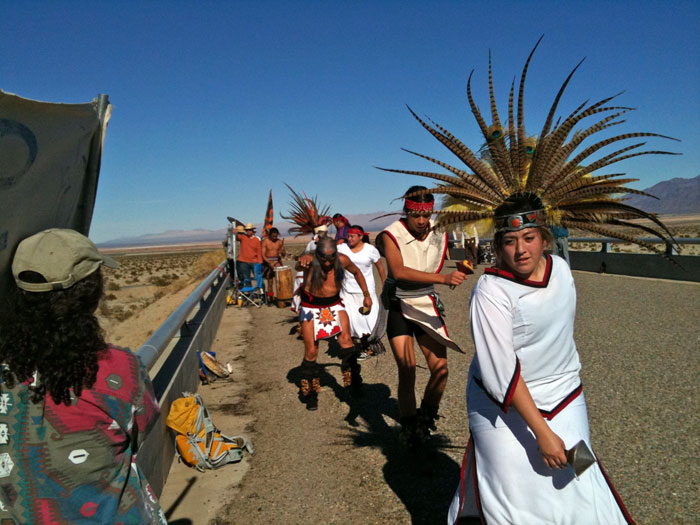
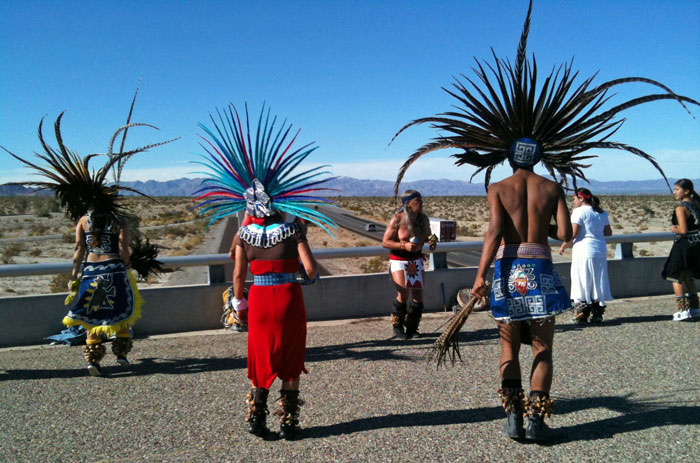
On Saturday afternoon, 12 Cuauhtemoc Dancers along with three drummers, danced, sang, chanted, drummed, burned white sage and Blessed the Chuckwalla Valley. The Dancers danced for four hours in full traditional garb. Donna Charpied, Executive Director of the Citizens for the Chuckwalla Valley was moved to tears by the Dancers. “It was really a very Spiritual element of the Chuckwalla Camp. At one point they were dancing and burning sage and over their shoulders in the distance I could see my farm that may one day be surrounded on three sides a mere 600 feet away with the First Solar’s 4,000 acre plus Desert Sunlight project. I was moved to tears when they Blessed that area. It felt as though the evil was being chased away.”
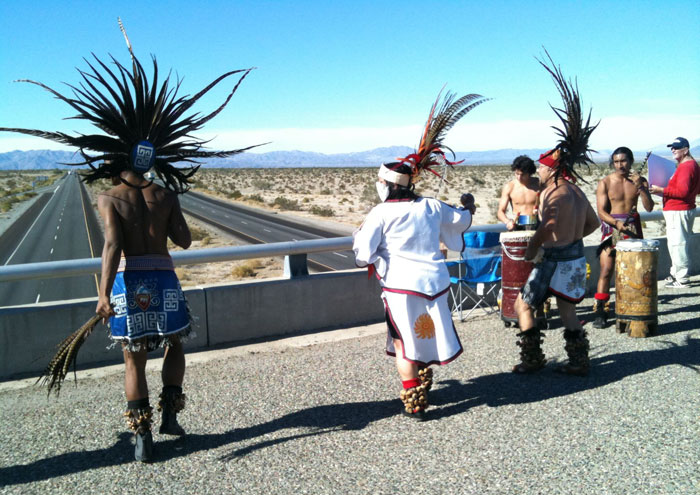
Alfredo Acosta Figueroa, founder of La Cuna de Atzlan Sacred Sites Protection Circle expressed concerns with Secretary of the Interior Ken Salazar's disrespect for Native scared sites. “We have an MOU (memorandum of understanding) with the BLM for the protection of sacred sites, including geoglyphs that are threatened by Big Solar. We had to sue the government to halt construction of the Blythe proposal. Ken Salazar’s background is with the energy sector. It’s no wonder these big solar schemes are being permitted so quickly”.
Scientists have revealed recently that desert soils are CO2 gobblers, and that scraping desert soils for large-scale solar power plants will hinder efforts to deal with Climate Change. Some people claim the jobs are important. A solar project requires about 400 people during construction then afterwards employ 15 to 20 people. If the government’s policies insisted on rooftop solar, solar panels in parking lots, and constructing close to the built environment a sustainable economic engine will be created, putting people to work for the long term.
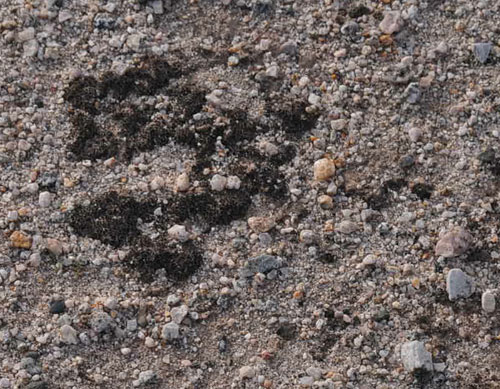
^Biological soil crust next to the protest site on the desert floor absorbs atmospheric carbon dioxide.
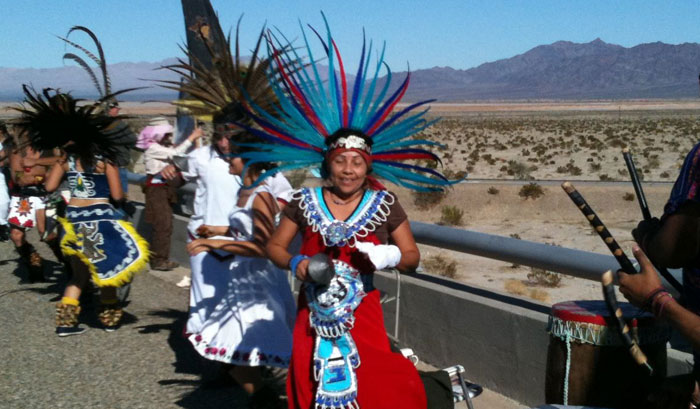
^Cuauhtemoc Dancers on the Corn Springs overpass, with the site of the proposed Palen Solar Power Project beyond.
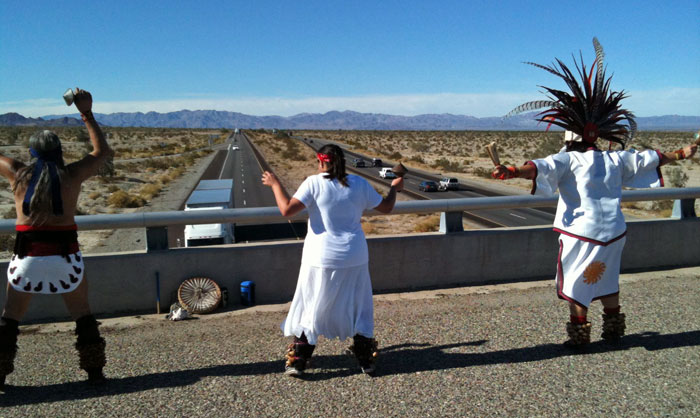
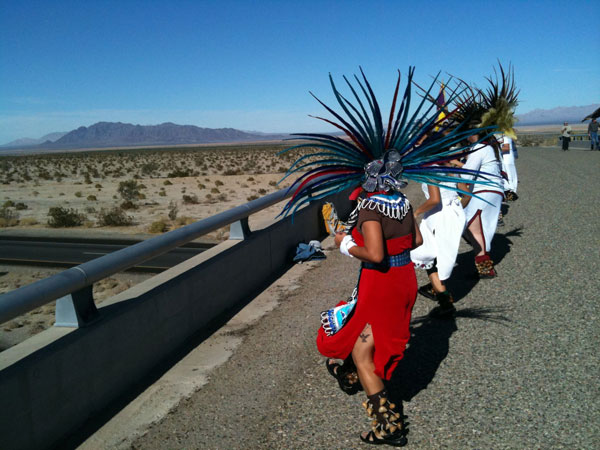
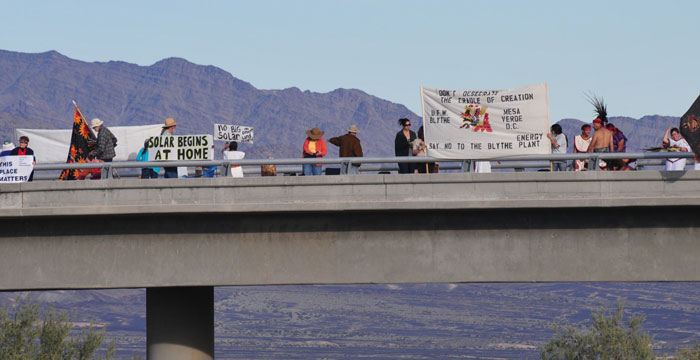
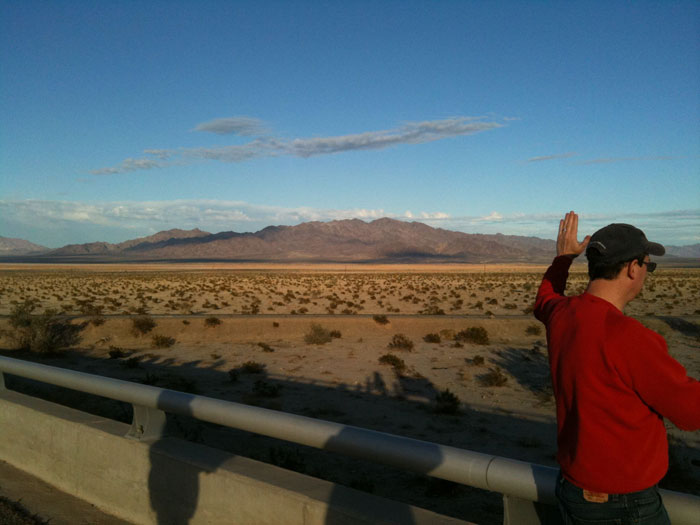
Waving to the cars and trucks on Highway 10. Palen Solar Power Project would cover the flat desert in the background.
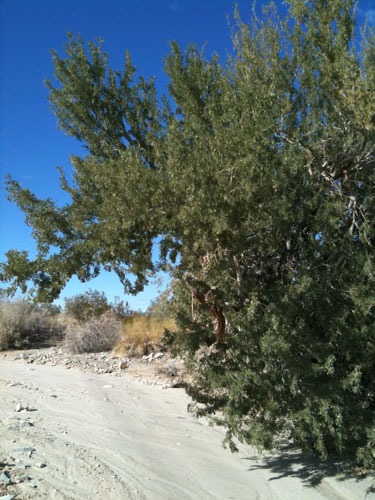
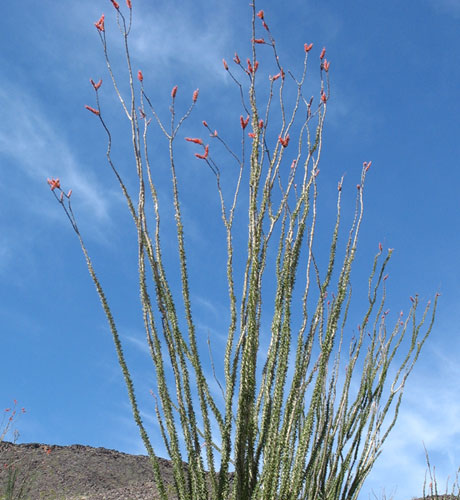
^Desert ironwood (Olneya tesota) trees would have to be cut down to make way for industrial solar plants.
Chuckwalla Valley Meet-up
January 4, 2011 -
Public Meetings on First Solar Desert Sunlight

^Rare Foxtail cactus (Coryphantha alversonii).
October 6, 2010 - The Bureau of Land Management (BLM) will hold public meetings to gather input on issues that should be addressed in the Environmental Impact Statement for the proposed Desert Sunlight Solar Farm Project near Desert Center in Riverside County.
Public meetings for the Environmental Impact Statement will be held Oct. 20 at the Lake Tamarisk Community Center, 26251 Parkview Drive, Desert Center, CA 92269 and Oct. 21 at the University of California- Riverside, Palm Desert Campus, 75080 Frank Sinatra Drive, Palm Desert, CA 92211. The meeting in Desert Center will run from 6 to 9 p.m. The meeting in Palm Desert will run from 9 a.m. to 12 p.m.
Desert Sunlight Holdings, LLC has applied for a right-of-way (ROW) authorization covering approximately 4,500 acres on public lands for a 550-megawatt solar photovoltaic (PV) project with an interconnection to the Devers to Palo-Verde I 500-kilovolt (kV) distribution system. As proposed by the company, the solar project would include the solar farm site (consisting of the main generation area, operations and maintenance facility, solar energy visitor center, an on- site substation and fencing), a 220-kV generation tie line, access routes and a new 500/220 kV substation at Red Bluff.
Information on the status of the proposal is available at http://www.blm.gov/ca/st/en/fo/palmsprings/Solar_Projects.html
For further information and/or to have your name added to the mailing list, contact Allison Shaffer, Palm Springs-South Coast Field Office, 1201 Bird Center Drive, Palm Springs, California, 92262, phone (760)-833-7100, fax (760) 833-7199, or email CAPSSolarFirstSolarDesertSunlight@blm.gov.
Potential issues to be addressed in the analysis include social and economic impacts; ground and surface water quantity and quality impacts; plant and animal species impacts, including special status species; impacts to cultural resources; and visual resource impacts.
First Solar Desert Sunlight Draft EIS Out
August 27, 2010 - Notice of Availability of the Draft Environmental Impact Statement for the Desert Sunlight Holdings, LLC Desert Sunlight Solar Farm Project and Possible California Desert Conservation Area Plan Amendment.
SUMMARY: In accordance with the National Environmental Policy Act of 1969, as amended (NEPA), and the Federal Land Policy and Management Act of 1976, as amended (FLPMA), the Bureau of Land Management (BLM) has prepared a Draft Environmental Impact Statement (EIS) and Draft California Desert Conservation Area (CDCA) Plan Amendment for the Desert Sunlight Holdings, LLC Desert Sunlight Solar Farm (DSSF) Project, Riverside County, California, and by this notice, is announcing the opening of a 90-day public comment period.
DATES: To ensure that comments will be considered, the BLM must receive written comments on the Draft EIS within 90 days following the date the Environmental Protection Agency publishes its Notice of Availability in the Federal Register. The BLM will announce future meetings or hearings and any other public involvement activities at least 15 days in advance through public notices, media releases, and/or mailings.
ADDRESSES: You may submit comments related to the Desert Sunlight Holdings DSSF project by any of the following methods:
Web site: http://www.blm.gov/ca/st/en/fo/palmsprings.html.
E-mail: CAPSSolarFirstSolarDesertSunlight@blm.gov.
Fax: (760) 833-7199.
Mail or other delivery service: Allison Shaffer, Project Manager, BLM Palm Springs-South Coast Field Office, 1201 Bird Center Drive, Palm Springs, California 92262.
Copies of the DSSF Draft EIS are available from the Palm Springs-South Coast Field Office at the above address.
FOR FURTHER INFORMATION CONTACT: Allison Shaffer, BLM Project Manager, telephone (760) 833-7100. See also ADDRESSES section.
SUPPLEMENTARY INFORMATION: Desert Sunlight Holdings, LLC has requested a 19,516-acre right-of-way (ROW) to construct and operate the DSSF 550-megawatt (MW) solar photovoltaic (PV) facility and associated 220-kilovolt (kV) generation interconnection line (gen-tie line), and to facilitate the construction and operation by Southern California Edison (SCE) of a new 500- to 220-kV Red Bluff Substation where the project would interconnect with the SCE regional transmission system.
The DSSF power generation site would encompass 4,245 acres. The power generation site would consist of several components: A main generation area which includes PV arrays, combining switchgear, overhead lines, and access corridors; an operations and maintenance facility; a solar energy visitor center; an on-site substation where the voltage of the generated electricity would be stepped up to 220 kV to match that of the transmission line; and site security and fencing.The transmission line from the project would transmit the electricity to the regional transmission system through the Red Bluff
Substation where the power would feed into SCE's existing Devers-Palo Verde 1 (DPV1) 500-kV transmission line. The length of the transmission line would be 12.2 miles long involving 236 acres. The Red Bluff Substation would consist of a 500/220 kV substation
on approximately 90 acres, with an additional 20 to 30 acres for related features including access roads and drainage control. Substation features include: Connection of the project tranmission line into the substation; transmission lines to connect the substation to the DPV1 line; modification of DPV1 towers near the substation; construction of an electric distribution line for substation light and power; and installation of telecommunications facilities.
The DSSF project would be located approximately six miles north of Interstate Highway 10 and the rural community of Desert Center in Riverside County. The project area is within two miles of Joshua Tree National Park. The Draft EIS analyzes the direct, indirect, and
cumulative impacts to the environment. Three action alternatives and three no project alternatives are analyzed in the Draft EIS.
Alternatives include: The proposed action; A modified proposed action with an alternative
transmission line route and substation location; A modified proposed action with a reduced project footprint (3,045 acres) and reduced output (413 MW); No action with no plan amendment to the CDCA plan; No project approval with a plan amendment to the CDCA plan to make the project area unsuitable for solar energy projects; and No project approval with a plan amendment to the CDCA plan to make the project area suitable for other solar energy projects.
The BLM's purpose and need for the DSSF project is to respond to Desert Sunlight Holdings' application under Title V of FLPMA (43 U.S.C. 1761) for a ROW grant to construct, operate, and decommission a solar PV facility on public lands in compliance with FLPMA, NEPA, BLM ROW and land use planning regulations, and other applicable laws and
regulations. The BLM will decide whether to approve, approve with modification, or deny a ROW grant to Desert Sunlight Holdings for the proposed DSSF project. The BLM will also consider amending the CDCA Plan to make the project area (or portions) either available or unavailable to future solar development. The CDCA Plan (1980, as amended), while recognizing the potential compatibility of solar generation facilities with other uses on public lands, requires that all sites proposed for power generation or transmission not already identified in the plan be considered through the plan amendment process. If the BLM decides to grant a ROW, the BLM would amend the CDCA Plan as required based on guidance in the BLM Land Use Planning Handbook (H 1601-1). The inventory for wilderness characteristics was updated and the project area was found to lack wilderness
characteristics.
A Notice of Intent to prepare an EIS and possible CDCA plan amendment for the DSSF was published in the Federal Register on January 13, 2010 (75 FR 1801). This was followed by a 30-day public scoping period which ended February 13, 2010. Scoping meetings were held on January 28, 2010, in Palm Desert, California. Numerous public scoping comments were received. The main concerns identified during scoping included potential impacts to biological, visual, water, and air resources, wilderness characteristics and cumulative impacts resulting from the potential development of the Interstate Highway 10 corridor. The issues and concerns identified in the scoping comments were addressed in the Draft EIS.
Please note that public comments and information submitted including names, street addresses, and e-mail addresses of persons who submit comments will be available for public review and disclosure at the above address during regular business hours (8 a.m. to 4 p.m.), Monday through Friday, except holidays, and at the following Web site:
http://www.blm.gov/ca. Before including your address, phone number, e-mail address, or
other personal identifying information in your comment, you should be aware that your entire comment--including your personal identifying information--may be made publicly available at any time. While you can ask us in your comment to withhold your personal identifying information from public review, we cannot guarantee that we will be able to do so.
First Solar Stock Declines
March 22, 2010 - Overcapacity of photovoltaic panels from China may be causing concern for Arizona-based First Solar, which is planning multiple utility-scale PV projects on public and private lands in the desert.
Investors retreat amid fears that a solar panel oversupply driven by China and public policy uncertainties in the West are still slicing profit margins too thin. China's manufacturers are churning out solar panels despite a potential slowdown in European markets where countries are trimming subsidies that support demand. But falling solar panel costs have helped increase consumer demand.
Stocks on the WilderHill Clean Energy Index, listed as ECO by the New York Stock Exchange, have dropped 10 percent this year. The index includes renewable energy and clean-energy technology stocks, with a significant solar component.
"There is brutal competition," Molchanov said. "With China emerging as a dominant player in solar manufacturing, it is difficult for Western players."
First Solar has also seen its stock decline since December as wary investors express concern about whether sales will net $2.9 billion in 2010 as projected by CEO Robert Gillette. First Solar is competing with China's huge Suntech Power Holdings. Analysts and investors soured after the company issued a guidance late Thursday predicting it would miss its earnings targets in 2010. SunPower's growth is declining as a flurry of recent acquisitions and partnerships has exploded the company's fixed costs.
WWW.EENEWS.NET/CLIMATEWIRE/2010/03/22
Solar Projects
January 28, 2010 - Chuckwalla Valley is getting filled with large solar proposals (see Bureau of Land Management Palm Springs South Coast Feild Office):
First Solar Desert Sunlight - thin-film cadmium telluride project surrounding private property and occupying tortoise habitat. Next to Desert Center and Joshua Tree National Park.
Solar Millennium Palen - 10 miles east of Desert Center. Parabolic trough solar thermal project, 484 MW on 3,800 acres. (California Energy Commission website >>here)
Solar Millennium Blythe - Parabolic trough solar thermal project, 8 miles west of Blythe, California. 968 MW on 6,300 acres. (California Energy Commission website >>here)
NextEra Ford Dry Lake Project (Genesis Solar Project) - 250 MW parabolic trough solar thermal project, wet-cooled. (California Energy Commission website >>here)
Solar Contractor Fired for Trespassing
December 18, 2009 - Greg Miller, Renewable Energy Coordinator for California Bureau of Land Management told us (personal communication) that the contractor for First Solar who was trespassing on private land during surveys, leving survey markers on public land (as trash), and driving off roads into Desert tortoise habitat. First Solar wants to build a massive thin-film photovoltaic panel field in Chuckwalla Valley. (See story of the trespassing >>here)
Here It Comes - Industrialization of the Desert
Ask BLM to extend the comment period on these projects!
November 27, 2009 -
We are quite concerned with the rush of fast-tracked solar energy projects in Chuckwalla Valley that will potentially ruin this Colorado Desert area. Bureau of Land Management is announcing new projects and public scoping comment periods, but not yet releasing Plans of Development. This prevents the public from reviewing the impacts to the southern edge of Joshua Tree National Park, the vast Ocotillo and wildflower flats, forested Ironwood washes, Desert tortoises, and Burro deer. Fast-tracking allows corporations to gain federal grants and subsidies if they start building by December 2010, yet short-changes the public the chance to have a say about how their lands are managed.
Here are the projects that have gained momentum recently:
 NextEra Ford Dry Lake Solar Power Plant/Genesis Solar Energy Project
The Bureau of Land Management (BLM) released a
Notice of Intent To Prepare an Environmental Impact Statement/Staff Assessment for a 1,800-acre parabolic trough solar thermal development at Ford Dry Lake near Desert Center in Riverside County, California.
The project is located about 25 miles west of the city of
Blythe, California, on BLM-managed lands. The project area is south of the Palen/McCoy Wilderness Area and north of Ford Dry Lake and Interstate 10.
NextEra Energy Resources, LLC, a subsidiary of Florida-based FLP Group, announced that it has entered into acontract to sell 250-megawatts of solar thermal power from the proposed to Pacific Gas and Electric Company (PG&E). It would be comprised of two 125-megawatt units. The project would also include a substation, administration facilities, operations and maintenance facilities, evaporation ponds, surface storm water control facilities, and temporary construction lay-down areas.
Of great concern in this arid desert valley, NextEra is proposing to use a wet cooling tower for power plant cooling. This is an intensive use of groundwater and we feel it is unsustainable. Water for cooling tower makeup, process water makeup, and other industrial uses such as mirror washing would be supplied from on-site groundwater wells. Project cooling waste water would be piped to lined, on-site evaporation ponds.
NextEra Energy Resources has nearly 20 years of experience operating similar technology at its SEGS solar facilities in the Mojave Desert.
An amendment to the California Desert Conservation Area (CDCA) Plan would have to be undertaken to allow solar development here, as with most solar projects in the California desert.
If approved, project construction would begin in late 2010.
COMMENTS on issues may be submitted in writing until December 23, 2009. Comments may be submitted at:
Web site: http://www.blm.gov/ca/st/en/fo/palmsprings.html
or http://energy.ca.gov/sitingcases/genesis_solar/index.html.
E-mail: CAPSSolarNextEraFPL@blm.gov or mmonasmi@energy.state.ca.us.
Fax: (760) 251-4899.
Mail: Mike Monasmith, Project Manager Siting, Transmission and Environmental Protection Division, CEC, 1516 Ninth Street, MS-15, Sacramento, California 95814 or Allison Shaffer,
Project Manager, Palm Springs-South Coast Field Office, BLM, 1201 Bird Center Drive, Palm Springs, California 92262.
[Federal Register: November 23, 2009 (Volume 74, Number 224), Page 61167-61168, wais.access.gpo.gov]
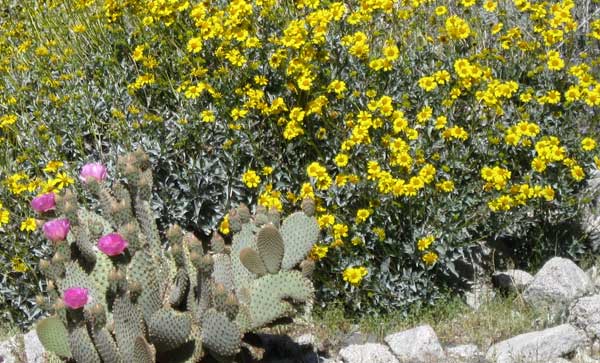
^Brittlebush (Encelia farinosa) and Beavertail cactus (Opuntia basilaris) in spring.
First Solar Desert Sunlight Power Project
This is a BLM California Fast-Track project that has started through environmental review.
First Solar was caught trespassing on private land recently, as well as driving over tortoise habitat on public land near Desert Center >>here.
It is a proposed project for a thin film technology, photovoltaic array, electrical generating facility capable of generating a maximum of 550 MW of renewable power.
The proposed project site is located on approximately 9,510 acres of federal land managed by the BLM in Riverside County, California, approximately 5.7 miles north of the community of Desert Center. The proposed site is 7 miles north of the I-10 transmission corridor.
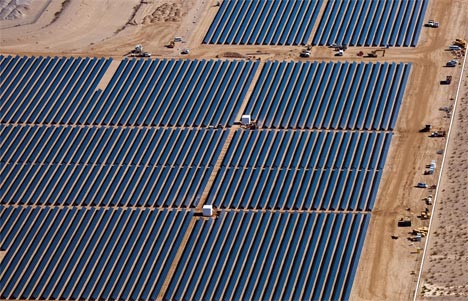
<First Solar built this 10 MW photovoltaic array after scraping creosote desert in Eldorado Valley near Boulder City, Nevada. It is now owned by Sempra. See >>more.
Pending approval by state regulators, construction will begin on Desert Sunlight in 2012. Southern California Edison would cooperate in the project. The Tempe, Arizona, company would use its own cadmium-telluride panels. The company began to pursue project development activities in earnest earlier this year when it purchased the unfinished projects from OptiSolar. OptiSolar, based in Hayward, California, had trouble raising enough money to continue developing the projects while also manufacturing its own solar panels.
First Solar, whose largest market is Germany, is using these projects to drive demand for its solar panels in North America. It already has built a 10-megawatt project in Nevada for Sempra Generation (see photo), which is selling the electricity from that project to PG&E. For its deals with Edison, First Solar would build the solar power plants and then sell most or all of its equity stakes in them to investors or power producers by the time it completes the projects.
See:
http://www.blm.gov/ca/st/en/fo/cdd/alternative_energy/fast-trackfastfacts.html
http://www.reuters.com/article/GCA-GreenBusiness/idUSTRE57H3OH20090818
http://www.greentechmedia.com/articles/read/first-solar-to-build-550mw-for-socal-edison/
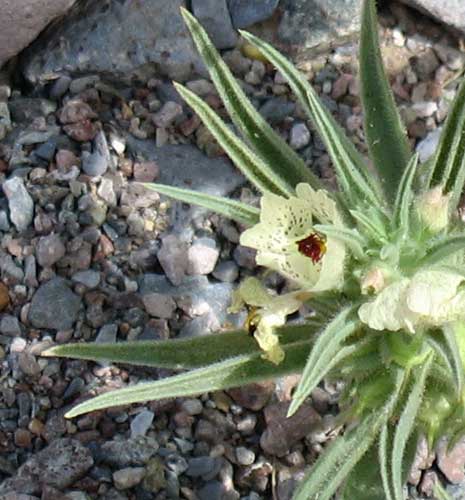
^Ghost flower (Mohavea confertiflora).
Devers Palo Verde2 Transmission Line
To carry all this potential future renewable energy from the remote deserts to Los Angeles and other southern California cities, new transmission lines must be built. The idea was to link this line to Palo Verde Nuclear Power Plant in Arizona, although that state has not readily agreed to being the energy sprawl backyard to California's unsustainable growth.
Submitted in 2005, Southern California Edison's (SCE) Devers Palo Verde2 Transmission Line was approved on November 20, 2009 by the California Public Utilities Commission.
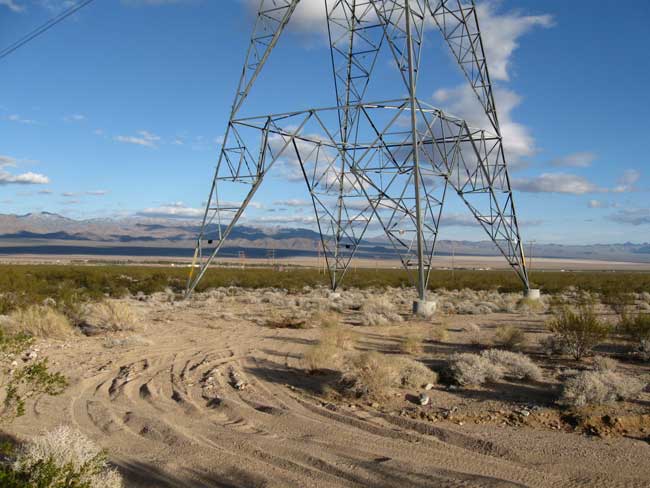 The DPV2 Project as proposed by SCE includes a new 230-mile 500 kV line from the Harquahala Substation (in Arizona, near the Palo Verde nuclear power plant) to SCE's Devers Substation (in North Palm Springs, California). The 500 kV portion would follow the existing SCE 500 kV transmission line, Devers–Palo Verde No. 1 (DPV1).
The California portion of the project currently is expected to be placed in service in 2013, subject to licensing and regulatory approvals.
The California Public Utilities Commission approved the entire proposed project, but in June 2007 the Arizona Corporation Commission denied the Arizona portion of the project. The Arizona regulators dismissed the project as allowing California to plug a “230-mile extension cord” into its generation supply, something they found untenable at a time when Arizona's own population was growing rapidly.
The DPV2 Project also includes upgrades to an additional 50 miles of 230 kV transmission lines west of the Devers Substation. Forty miles of 230 kV transmission line from Devers Substation to San Bernardino Junction at the western end of San Timoteo Canyon would be reconfigured and two separate 230 kV corridors, from San Bernardino Junction to SCE's Mountain View Substation and from San Bernardino Junction to SCE's Vista Substation would be reconductored.
The Final Environmental Impact Report/Environmental Impact Statement (Final EIR/EIS) was issued on October 24, 2006. Over 475 pages of comments on the Draft EIR/EIS were submitted to the BLM and the CPUC, including transcripts from the July 2006 Public Participation Hearings.
 The 1200 MW line has an estimated cost approximately of $600 million.
There has been talk of the Federal Energy Regulatory Commission (FERC) stepping in and bypassing stubborn state regulators in favor of transmission lines with "national interest."
The Arizona portion of the line would cut right through the northern part of Kofa National Wildlife Refuge, an area of bighorn sheep herds and native California fan palm groves in Yuma County of western Arizona, southeast of Blythe, California.
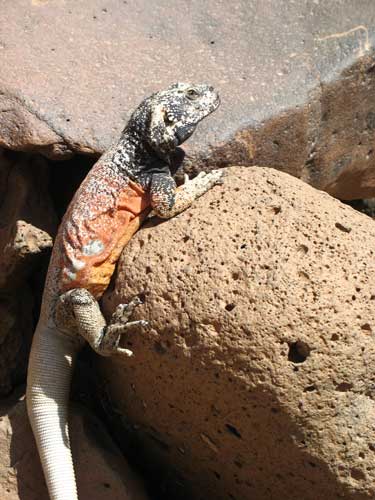
<Colorful male Chuckwalla (Sauromalus obesus) in the Chocolate Mountains area, Riverside County, California, next to Chuckwalla Valley.
See these websites for more on the DPV2 transmission line:
http://www.cpuc.ca.gov/Environment/info/aspen/dpv2/dpv2.htm
http://www.energylegalblog.com/archives/2007/06/13/1422
HOME.....Solar Energy Study Areas.....Palm Desert Congressional Hearing on Renewables
