Death Valley National Park Dust

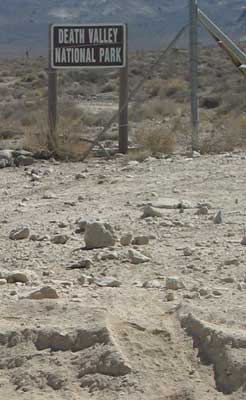
Although Bureau of Land Management (BLM) did a good job of controling dust from the off road race by Beatty and ranches in Oasis Valley (after many complaints), the situation was far worse along the borders of Death Valley National Park.

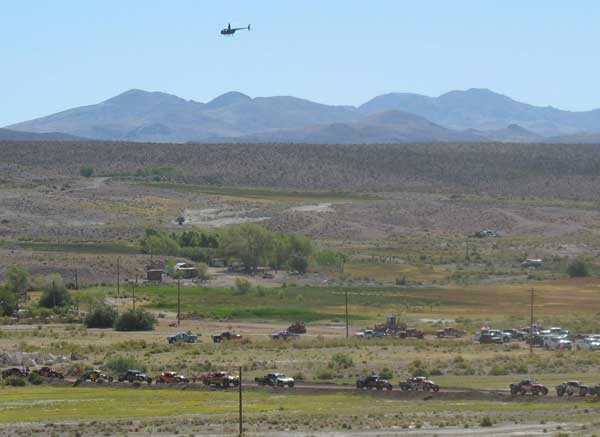
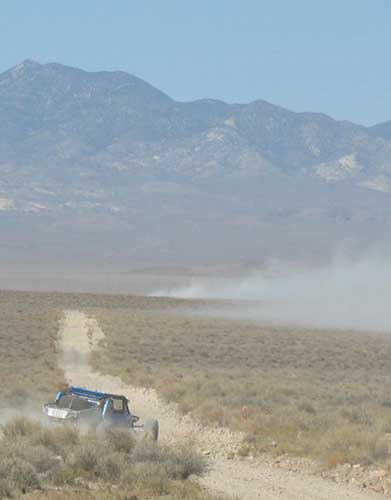
We watched as racer after racer sped down a wash and onto the dirt road that park visitors use to access Strozzi Ranch in the Grapevine Mountains on Death Valley's eastern edge.

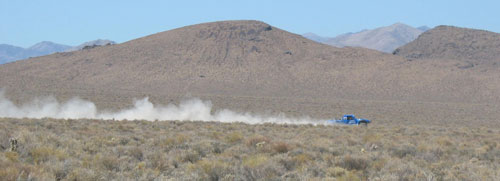
The silty powdered dirt rose in clouds a thousand feet high, or blown around by winds. Friends told us that this may impair their plans to camp here and bring telescopes to watch stars in the night sky.

The race route actually goes along the park boundary fence in the "Nevada Triangle" for several miles -- within a few feet of park land. Then it vears off along another small access road north towards Scotty's Junction.

After the race, these small dirt access roads were almost impassable to all but tourists with high-clearance vehicles in 4-wheel-drive, plowing through piles of dust and over deep new ruts.

Thrashed tires and whole wheels were left as trash on our public lands. Whirlwinds and dust-devils filled the air with haze from the ripped-up race track, the long-term legacy of the race for folks who live here and visit the park.

In addition, we found two separate tracks used by the 2008 racers, the park access road and a new track cut through desert flats, paralleling each other for miles in Sarcobatus Flat -- how many roads do we need in this community of Nevada ephedra, shadscale, Desert needlegrass, and Budsage? Sidewinder tracks and kangaroo rat footprints covered the race dust as animals ventured out at night.

Race organizers and BLM's Tom Seley (Tonopah Field Statiuon Manager) say they will clean up trash and help the county fix and grade these roads in October 2008. We will be watching.

More PHOTOS

Amargosa Toad Habitat Impacted

The Center for Biodiversity challenged the race organizers and BLM to change the route through Oasis Valley after 2007 racers ran precariously close to springs and meadows where the endemic Amargosa toad (Bufo nelsoni) lives.

In February 2008 the Center petitioned the U.S. Fish and Wildlife Service to list the toad as threatened or endangered under the federal Endangered Species Act (this is pending). The toads are having enough trouble with development and water threats to its habitat, and did not need more habitat damage and road-kill concerns from OHVs.

In response, BLM changed the route to begin north of Beatty (although still in toad habitat) and to slow the speed of racers near springs and wetlands where toads dwell.

Tom Seley, Tonopah Field Office manager (BLM), has done a great job of listening to residents' concerns, trying to balance how public land around here is utilized.

Monitoring the situation, we noticed that in 2007 race cars barreled down a wash a mere 500 yards from Crystal Spring, a toad breeding pond. This year the racers were required to slow to 25 mph and avoid going near this spot. In addition, the federally threatened Desert tortoise inhabits the region north into Sarcobatus Flat.

Amargosa toads

Nevada Off Road Race Tears Up the Desert
August 22, 2008 -- Beatty, Nevada

The quiet Oasis Valley was awakened early this morning by no less than six helicopters rushing by in a hurry to get to the staging area of the largest off road race in the U.S. Motors rumble and pickup trucks loaded with gas cans crowd the sides of Highway 95, as everyone waits for the race to begin from the staging area five miles north of the the small historic mining town of Beatty in Nye County.

More than 200 race-cars lined up at the starting road (which heads to the ghost town of Pioneer), engines revving, most custom-fitted with large tires to speed as fast as 100 mph on shrubby desert surfaces and washes. First a group of motrocycles take off. Next lines of race cars drive from the staging area on private land, across Highway 95 (stopping traffic for periods of time on the busy interstate for an hour as flaggers controlled traffic). As they rev up to race in groups, we see clouds of dust come up from the canyons in the Bullfrog Hills as the racers head north at high speed through the Mojave Desert and into the Great Basin.

Terrible's "Best in the Desert"
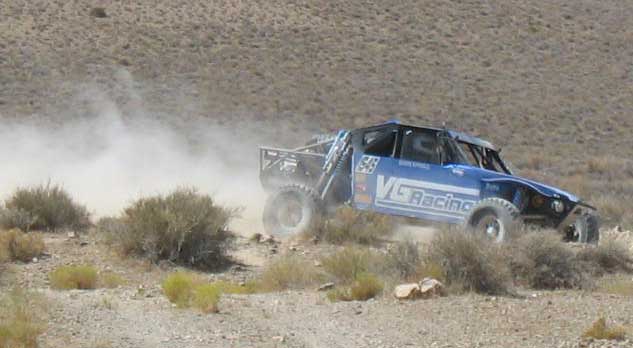
The annual Vegas to Reno Off-Highway Vehicle Race, crossing hundreds of miles of public lands, some private lands, and county dirt roads, has had increasing problems from angry Nevadans. Clouds of dust lowering air quality, access roads ruined, habitat destroyed, and trespassing are some of the local complaints.

Originally a 550 mile race starting in 1996 (although 2,000 miles long across the entire state in the year 2000), the distances and routes have changed through the years as the main land-managing agency, BLM, has modified its Environmental Assessment (EA). The race is now 456 miles long.

Residents of Amargosa Valley to the south last year banned the race from their area due to damage caused on powerline roads and dust issues. Beatty people told their town council at meetings that local roads were impassable after the race went by, and that racers were often rowdy. Nye County voted not to support the race this year as well.

We talked to one long-time resident of Oasis Valley who told us that ten years ago the racers went so close to one spring that they "kicked dirt into it." The spring is currently Amargosa toad habitat (see sidebar). Helicopters circled over her during last-year's race, and several associated vehicles trespassed on her land. "They were rude! I was scared to go out of my house!"
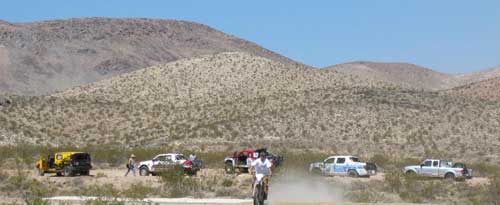
Racers line up on Pioneer Road at the start of the race.

BLM specified that the race go in washes and pre-exisiting roads. But this race often goes over habitat that we would not consider washes or bedrock, but desert shrub basin communities, places where no pre-existing road occurred. The desert track can be rough -- in 2007 a racer died in Esmeralda County.

After the close of the Barstow to Vegas race in California in the 1980s, Nevada is the last state to allow a race of this magnitude.

See the Best in the Desert website at www.bitd.com.
--L.M.

2009 UPDATE: OHV Use in Nevada Public Lands

More start PHOTOS and Photos by Death Valley National Park.

Access road ruined for tourists.


What You Can Do- The last BLM Environmental Assessment (EA) for the race came out in 2004. A new EA is due, and BLM will decide whether to do one for the entire event, or multiple EAs for the varied districts. They will send out a scoping letter to the public to identify issues. Tell BLM that the next EA should address such topics as:

1. The effects of the race on private property rights.

2. Dust from erosion that damages air quality and viewscapes.

3. Impacts next to Death Valley National Park.

4. Impacts to Amargosa toad habitat in Oasis Valley.

5. Helicopters in places where people live to avoid dust and noise issues.

6. The permitee should be financially responsible for the repair of all damaged roads. More careful monitoring to keep tracks to one and not multiple simultaneous paralleling race routes.

7. BLM needs to have a state-wide monitoring program before, during, and after the race.

8. Erosion causes increased spread of invasive plants, elevating fire hazards.

9. Look for alternative staging areas away from Oasis Valley biodiverse wetlands.

10. More monitoring of the race, including considering Desert tortoise surveys.

Send comments to Tom Seley, BLM Tonopah Field Office, 1553 South Main Street, P.O. Box 911, Tonopah, NV 89049. Thomas_Seley@blm.gov

Related websites:

Center for Biological Diversity- www.biologicaldiversity.org

Public Employees for Environmental Responsibility- www.peer.org

Death Valley National Park- www.nps.gov/deva

Comments? Sign in to our GUEST BOOK>>