BrightSource Withdraws Hidden Hills Application
May 30, 2015 - Just a few days after Inyo County requested termination by the California Energy Commission of the Hidden Hills solar power tower project, BrightSource Energy sent in its withdrawal notice. This ends the project proposal.
Inyo County Asks to Terminate Hidden Hills Solar Power Tower
May 28, 2015 - Inyo County today requested the California Energy Commission terminate the Hidden Hills Solar Electric Generating System application, citing the county General Plan Amendment extensively analyzing land use and renewable energy development guidelines, especially the part of the resolution that would allow only photovoltaic installtions and not concentrated solar thermal plants. The plan amendment was partly funded by a CEC grant and is in concert with Desert Renewable Energy Conservation Plan.
See the letter to the California Energy Commission >>here.
CEC Schedules Hearing Over Suspension Continuation
May 11, 2015 - The California Energy Commission (CEC) issued a notice that it will hold a hearing on the Applicant BrightSource Energy's motion to continue supsension of their solar power tower proposal in eastern Inyo County CA, and CEC staff's motion to terminate the proceeding. The hearing will be held in Sacramento CA on June 3 at 10 AM. The CEC Committee will conduct the hearing to allow the parties to submit evidence and argument.
See the Notice >>here.
Hidden Hills Solar Power Tower: Energy Commission Moves to Terminate
April 17, 2015 - The California Energy Commission staff made a motion today to terminate the Hidden Hills Solar Electric Generating System, mostly in response to Inyo County's Renewable Energy General Plan Amendment which had specific limitations, such as photovoltaic only (no solar thermal power towers). They said:
"Applicant’s failure to meaningfully fulfill its status report requirements, and failure to timely file a renewed request for suspension, are by themselves sufficient basis for terminating the proceeding. However, there is an additional reason that supports termination beyond 'failure to pursue with due diligence.' That reason is the recent adoption by Inyo County of a Renewable Energy Plan (General Plan Amendment No. 2013-02). The general plan amendment (Amendment) was the product of Inyo County’s participation in the Desert Renewable Energy Conservation Plan, and was financed with grant funding from the Energy Commission to do comprehensive planning on the county level for renewable energy development. (Inyo Co. Resolution No. 2015- 26, March 24, 2015, p.2.) The Amendment is the product of extensive public outreach, consultation with public agencies, consultation with Native American tribes, and a full- blown environmental impact report process that considered extensive project alternatives. (Id., pp. 2-11.)
"The Amendment creates several'“solar energy development areas, or 'SEDAs.' The SEDA for Charleston View—the proposed site of the Hidden Hills project--requires any future solar project at the Hidden Hills site to be photovoltaic, and to be no more than 2400 acres in size (compared to the proposed project’s 3277 acres). (Id., Exh. 5, Table 3-1, p.7.) The Amendment thus addresses, and largely avoids, the significant adverse environmental impacts identified by Staff in the Final Staff Assessment (FSA) for the project: potential impacts on local wells resulting from the need to pump relatively large quantities of groundwater from a declining aquifer for the project; potential impacts on local springs (and sensitive local habitat) from such water pumping; potential noise and visual impacts on local residents near the project site; significant visual resources impacts from 750-foot 'power towers'; significant impacts to Native American cultural resources, including the use and significance of local lands that would be occupied and visually dominated by the project; potentially significant impacts to birds from solar flux burn and heat damage.
"Inyo County is an intervenor in the Hidden Hills proceeding, and its new plan for renewables that may be situated in the county is informed by the impacts discussed in the FSA, and the need to reduce or avoid them. In fact, the county contributed importantly to the FSA’s assessment. The project would not be, and cannot be, consistent with the county’s plan, which leaves room for solar projects better suited for the Hidden Hills site. The county, local residents, intervenors, environmental groups, and the federal Bureau of Land Management (which administers adjacent federal lands) are currently left uncertain as to whether the county’s newly adopted plan for photovoltaic solar development is controlling, or whether the Energy Commission will ultimately override that plan to license Applicant’s project.1 In this context, Applicant’s failure to comply with even the most basic duties of its suspension orders, and respond with substantive information about project progress, are factors the Commission should consider before, once again, renewing suspension for a project that would have high adverse impacts if located at the proposed site.
See the CEC Motion.
The Commisssioners will review this motion and we hope make a decision soon whether to terminate the project.
BrightSource Looking for Utility to Buy Hidden Hills Solar Power Tower Electricity
February 3, 2015 - According to a status report sent by BrightSource Energy to the California Energy Commission yesterday, the company is seeking buyers for its proposed Hidden Hills Solar Electric Generating System project. It said, "The applicant is actively monitoring and participating in the 2015 renewable procurement RFO’s with CA IOU’s. The 2015 procurement window will run through Q2 2015 wherein the applicant will be bidding-in the BrightSource power tower CSP platform."
But BrightSource also said it is seeking a project partner to help build the project. We beleive the company will seek to integrate thermal storage with their power tower design to make the massive and expensive solar project more appealing to the California market.
BrightSource Suspends Project
April 3, 2013 - Following a similar suspension of their Rio Mesa project near Blythe CA, BrightSource Energy sent a notice today to the California Energy Commission saying there is a need to suspend their application for certification indefinitely. The Oakland-based company said it did not want to withdraw the application but only delay it for an unspecified amount of time.
Possible financing issues may be weighing on the project, but the larger culprit appears to be the need for a speedy review and approval to meet federal solar tax credit deadlines in 2016.
The big hitch may be transmission, which has plagued so many large-scale remote renewable energy projects. The lack of transmission or the lengthy separate permitting process has hindered many developers. Power Purchase agreements for the Hidden Hills project had specific time frames that cannot be met by the schedule for construction of a transmission line on Bureau of Land Management land from Ivanpah Valley up past Good Springs, NV, to the Hidden Hills site near Pahrump. This process is a completely separate environmental review than the actual power plant process. Complications because the project lies in California and the transmission line passes through Nevada may also have played a roll in the delay.
Other factors in the suspension of the project may be that BrightSource wanted to add thermal storage to Hidden Hills, but this modification would require a new environmental review. In addition, the technology to convert heat energy from steam in the power tower to heat in molten salt storage tanks and then back to steam to turn turbines may lose so much efficiency that we question whether this technology can compete with CSP towers that use molten salt through the tower and storage system, such as that developed by Solar Reserve (see Crescent Dunes).
BrightSource is focusing on its other project, the Palen SEGS solar power tower near Desert Center CA.
See also KCET ReWire by Chris Clarke:
Hearing by California Energy Commission to License Project
March 18, 2013 - Our coverage of the evidentiary hearing carried out by the California Energy Commission reviewing the BrightSource Energy solar power tower project in Inyo County, CA. >>here.
Rare Plants In Peril
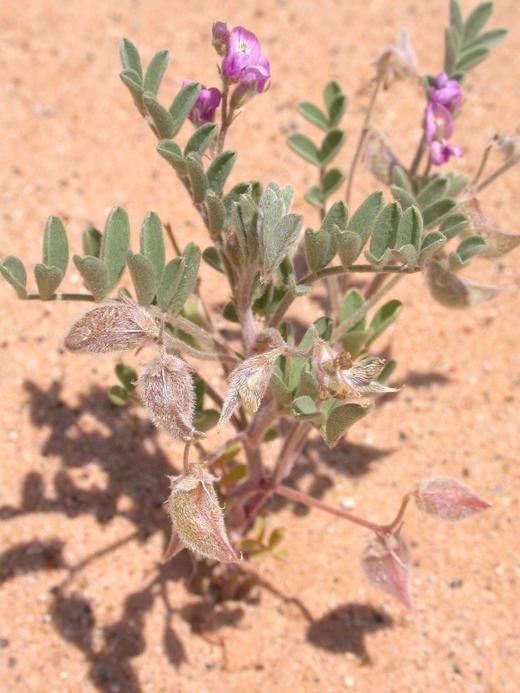
^Gravel milkvetch (Astragalus sabulonum) courtesy of Calphoto. Photo by James M. Andre, used with permission
February 7, 2013 - The California Native Plant Society (CNPS) sent a letter this week to the California Energy Commission regarding rare plant mitigation for the Hidden Hills solar project in Pahrump Valley on the California-Nevada border. In short, the mitigation was found to be completely inadequate. The rare gravel milkvetch (Astragalus sabulonum) has only 8 documented locations in California, and 4 of those will be destroyed by project impacts. These remaining sites face weed invasions and off-roading impacts. Because the Final Staff Assessment recommends a 2:1 mitigation for this species, only two of the offsite locations will be placed in conservation status. CNPS calls this "Kill 2: Save 1" and it does not bode well for the survival of the plant. CNPS strongly urged the Energy Commission to ask that all 4 remaining plant occurrences be actively conserved and protected.
Notice of Prehearing Conference and Evidentiary Hearing
December 24th, 2012 - the Committee designated by the Energy Commission will conduct proceedings on the Application for Certification (AFC) for the Hidden Hills Solar Electric Generating System (HHSEGS) has scheduled the Prehearing Conference and Evidentiary Hearings as follows:
The PREHEARING CONFERENCE will be conducted on:
TUESDAY, FEBRUARY 26, 2013
Beginning at 12:00 noon
TECOPA COMMUNITY CENTER
405 TECOPA HOT SPRINGS ROAD
TECOPA, CA 92389
The EVIDENTIARY HEARINGS will take place on:
TUESDAY, MARCH 12, 2013
WEDNESDAY, MARCH 13, 2013
THURSDAY, MARCH 14, 2013
And (if necessary) FRIDAY, MARCH 15, 2013
Beginning at 9:00 a.m. at:
DEATH VALLEY ACADEMY GYMNASIUM
127 OLD STATE HIGHWAY
SHOSHONE, CA 92384
Final Staff Assessment Released
December 21, 2012 - The California Energy Commission (CEC) as released the Final Staff Assessment for the Hidden Hills Solar Electric Generating System. It can be accessed and downloaded from the CEC website >>here.
Workshops Hammer Out Issues with Water and Safety
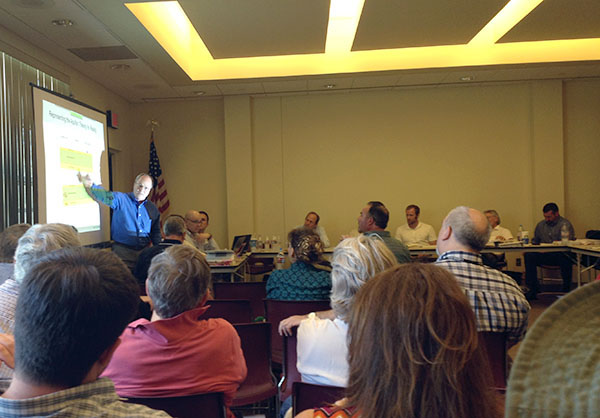
June 17, 2012 - During various workshops in Sacramento and local communities, the California Energy Commission (CEC) has been working with BrightSource Energy on their application to construct a large solar power plant, as well as with interveners and other stakeholders.
On June 14 a workshop was held in Pahrump, Nevada, near to the location of the project on the other side of the border with California, all in the same Pahrump Valley.
Water
Water was a big concern. Stump Springs to the east of the project is a valuable resource, and the wells of local residents in Charleston Heights are also an issue that need protection. CEC wants to try to limit groundwater declines from project pumping to close to zero at the springs. BrightSource agreed to a monetary compensation program for local well owners if there are ill effects to their wells by the power plant; the wells would be modified to ensure property owners continue to have water.
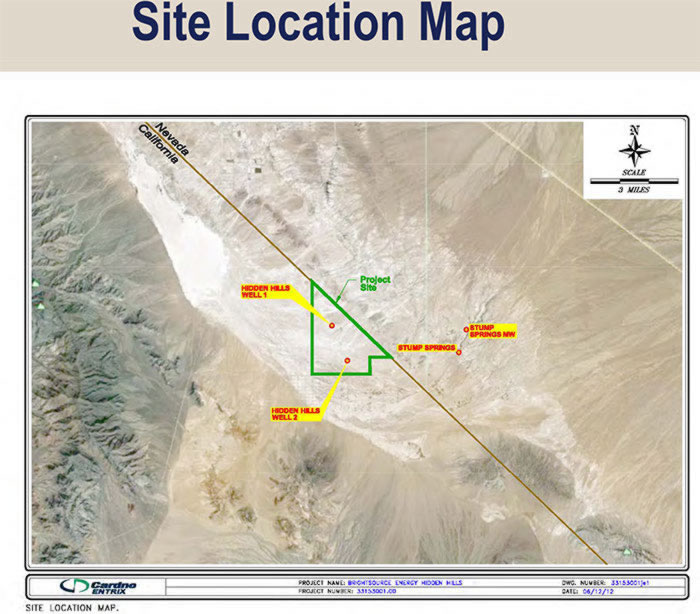
^Map of the solar project and wells. The residences of Charleston Heights are to the southwest of the project. (http://www.energy.ca.gov/sitingcases/hiddenhills/documents/applicant/2012-06-14_Applicant_Water_Consultant_PSA_Workshop_Presentation_TN-65767.pdf)
Clay Johnson, project manager for BrightSource, said the 148 acre-feet per year of water use during operation of the solar plant would have limited impact on wells. "We're like an alfalfa farm."
BrightSource did a well pump test at the request of CEC to learn more about the aquifer in the area, but the interpretations of the data were widely divergent between the applicant and the Energy Commission hydrologists. Most of the workshop was taken up by a debate on how to characterize the aquifer.
The hydrologist hired by BrightSource described the pump test they did in February, which was supposed to last 10 days, but only lasted a little over 4 days due to vandalism of the pump. The test ran the 1,000-foot-deep well pump at 45 gallons per minute (gpm) continuously on the proposed project site. They found the drawdown to be 1.5 feet. Wells being measured for many years at Stump Spring were lowering before the test began, and the BrightSource hydrologist said their test had no effect on Stump Springs wells. He said after 25 years he believed any cone of depression would not leave the boundary of the project site, or have very little impact beyond 1,500 feet from the wells.
The Hidden Hills solar project would have 2 main wells to supply water to the project, on site, and 2 back-up wells. Depth was 500 to 1,000 feet.
Nearby Charleston View wells were at a depth of 175 to 310 feet, most pumping at less than 30 gpm.
The applicant's hydrologist stated that he thought the pump test showed the aquifer could easily support the project, because the aquifer appeared to be a "leaky aquifer." During pumping, he was of the opinion that the aquifer would recharge due to leakance from fine-grained materials above and below the aquifer, which would lessen draw-down. He characterized the valley sediments as 150-200 feet of fine grained sediments below the ground surface, then a fine-grained aquifer holding water, then geological evidence indicating a finer grained layer at 1,000 feet below that. The valley fill sediments might go down to 8,000 feet to bedrock.
He also said they found a gradient of groundwater flowing from east to west through the project site, making the groundwater of Stump Springs higher than the project. Pumping would capture some of that flow, and allow a little less water leaving the site as came onto the site, but not effect Stump Springs.

^BrightSource interpretation of local aquifer characteristics.
The CEC hydrologist disagreed. He said the data fit a fully confined aquifer characterization better. They believed drawdown could reach Stump Springs at 30 years, and could even be several feet of lowering. There is still enough uncertainty. As for leakance, the hydrologist said not enough data was collected for a long period, there could be temporary leakance. "Where is it coming from?" asked the CEC hydrologist. The recharge must be looked at not locally but for the whole aquifer, and all evidence indicated the Pahrump Valley aquifer was not recharging. Storage is extremely low other tests showed. There may be confining units such as clay beds at Stump Springs, that a drawdown could impact. The Energy Commission hydrologist said it was mathematically impossible to have the BrightSource hydrologist's drawdown solutions. He said the applicant needed to reach out much farther in their analysis. A gradient in a confined system is not a source of recharge.
CEC wanted BrightSource to have 3 monitoring wells outside the project in a line with the proposed project wells, all at 1,000 feet deep. Two upstream from the project and one downstream. BrightSource said this would be too expensive. CEC said they might propose triggers that would require new mitigation, such as sending out biologists to monitor how the deep-rooted mesquite at Stump Spring react, and if they appear to be adversely affected, a new mitigation for pumping would be triggered. CEC said if they see a half-foot drop in water at the project boundary, then the assumption could be made that pumping might be affecting Stump Spring.
Some local residents said they were concerned about how the project would dry up their wells. One resident said her well lowered 7 feet a few years ago and she had to dig deeper. Another resident of Charleston Heights said when she came to Pahrump Valley in 1969, there were gushing artesian wells, that are now dry. In the 1940s and 50s the valley had mound springs that were lush and free-flowing; now these are dry. Another resident supported the project because it would be a development that used less water than a 5,000-acre housing development that was proposed years ago.
CEC said one condition of certification would be that the company must guarantee the residents have water over the 30 year lifespan of the project. BrightSource would also retire water rights in the Nevada side of the state line.
Brian Brown of the Amargosa Conservancy pointed out that their pump tests in cooperation with US Geological Survey in the Amargosa Valley showed surprising results. Some areas that were supposed to have water did not. Past Yucca Mountain Nuclear Repository testing, which was very extensive in Amargosa Valley, showed a complex picture of drilling hitting carbonate rocks at 200 feet and in other areas 2,000 feet -- there are buried mountain ranges under the valley sediments, it is not just a big fill basin. The Conservancy said BrightSource's pump test was inadequate, and they had an independent analysis of the test -- comments would be submitted to CEC. They want more monitoring wells farther out, towards California where unknown and potential connections with Amargosa Valley could be present.
A representative of the Pahrump Valley Pauite listed several wells of people he knew in the area which went dry since February. "In this town they keep this quiet because people want to sell real estate."
Safety and Emergency Response
A contentious issue has been the remoteness of the Hidden Hills solar project. Although it does not propose to use large quantities of hazardous materials such as explosive Therminol heating oil (the process will use super-heated steam), nevertheless natural gas will be burned in small quantities, and other chemicals, toxic materials, and fuels will be used at the facility.
Inyo County has been negotiating with the applicant on a special use tax to fund increased personnel to patrol and serve the area in case of emergency. The town of Pahrump is closer, but over the border in Nevada. They do not have a Hazardous Materials team, in case of spill. State laws and codes differ between Inyo County, California, and Nye County, Nevada. A mutual aid agreement may have to be worked out. The Southern Inyo County Fire Protection District retained counsel to negotiate with BrightSource on the need for increased resources to cover such a large project in so remote an area.
California Energy Commission Environmental Review Document Out
May 25, 2012 - For Immediate Release: Media Contact: Sandy Louey - 916-654-4989
Preliminary Staff Assessment Released for Hidden Hills Solar Electric Generating System Project.
SACRAMENTO - The California Energy Commission staff today released its preliminary analysis of the proposed Hidden Hills Solar Electric Generating System project.
In the preliminary staff assessment (PSA), Commission staff concluded, in all but six technical sections, with the implementation of recommended mitigation measures described in the conditions of certification, the proposed 500-megawatt (MW) solar thermal power project would comply with all applicable laws, ordinances, regulations, and standards (LORS) and that environmental impacts would be less than significant.
The six technical areas with either a significant, unmitigated impact, LORS non-compliance, or outstanding issues that need to be resolved through additional data, further discussion and/or analysis are: biological resources, land use, socioeconomics, worker safety/fire protection, transmission system engineering, and visual resources. The cultural resources section will be in a supplemental staff assessment that is scheduled to be filed on or before June 15.
The PSA is available at: http://www.energy.ca.gov/sitingcases/hiddenhills/documents/index.html
The PSA serves as the staff's initial evaluation of the environmental, engineering, public health and safety impacts of the proposed facility. The PSA is not a decision nor does it contain final findings of the Commission related to the environmental impacts or the project's compliance with local, state and federal legal requirements.
After a public comment period on the PSA, which will include two workshops scheduled for next month, staff will release a final staff assessment (FSA). The FSA will serve as staff's testimony at evidentiary hearings conducted by the committee of two commissioners reviewing the proposed project. The committee will issue a proposed decision based on evidence presented at the hearings. The proposed decision will be presented to the full Commission for a final decision.
The applicant for the project is Hidden Hills Solar Holdings, LLC, a wholly owned subsidiary of BrightSource Energy, Inc. The proposed project consists of two 250-MW solar thermal power plants. Each plant would use about 85,000 heliostats - elevated mirrors guided by a tracking system mounted on a pylon - to focus the sun's rays on a solar receiver that produces steam to generate electricity. The solar receiver is located atop a 750-foot tall solar power tower near the center of each solar field.
The project would be located on 3,277 acres of private land leased in Inyo County next to the Nevada border. The project site is about eight miles south of Pahrump, Nevada and about 45 miles northwest of Las Vegas. The transmission line and the natural gas pipeline would be located in Nevada on public land managed by the U.S. Bureau of Land Management.
The capital cost for the project is estimated to be $2.7 billion. If the project is approved, construction would be completed by the third or fourth quarter of 2015. Commercial operation of the first solar plant would begin the third quarter of 2015, with the second solar plant starting operation in the fourth quarter of 2015. The project would require an average of 637 workers during the 29-month construction period, with a peak of 1,033 needed during the 14th month. There would be 120 workers needed when the project is operational.
More information on the Hidden Hills project is available at:
http://www.energy.ca.gov/sitingcases/hiddenhills/
The Energy Commission staff will hold two public workshops to discuss the PSA and further
public participation in the HHSEGS proceeding at the times and dates listed above. Based on
the workshop dialogue, written comments received regarding the PSA, and additional
information that will be gathered, the Energy Commission staff will revise the PSA where
appropriate and issue a Final Staff Assessment (FSA).
Notice of Public Workshops:
Thursday, June 14, 2012
10am - 7pm (or end of discussions)
Pahrump Public Library
701 East Street
Pahrump, NV 89048
WebEx Call-in toll-free number: 1-866-469-3239
( Access code: 929 367 339 )
( Meeting Password: Meeting@10 )
&
Wednesday, June 27, 2012
9am - 7pm (or end of discussions)
Home Street Middle School Library
730 Home Street
Bishop, CA 93514
WebEx Call-in toll-free number: 1-866-469-3239
( Access code: 922 518 173)
( Meeting Password: Meeting@9 )
For complete details please see the notice.
http://www.energy.ca.gov/sitingcases/hiddenhills/notices/index.html
Old Spanish Trail Concerns Come Up
January 24, 2012 - California Energy Commission is proposing an alternative in Sandy Valley for the Hidden Hills site due to cutlural issues. The site would lie on the Inyo-San Bernardino County line south of the present site. See Map on Sandy Valley Alternative page.
Hidden Hills Site Visit and Hearing
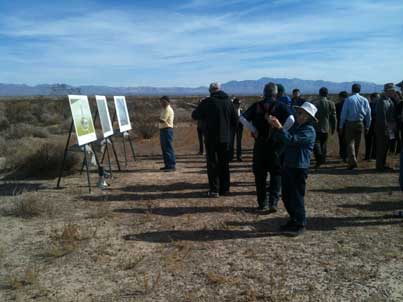
November 3, 2011 - Basin and Range Watch attended a site visit and Informational Hearing hosted by the California Energy Commission at Tecopa, in Inyo County, California.
The Project
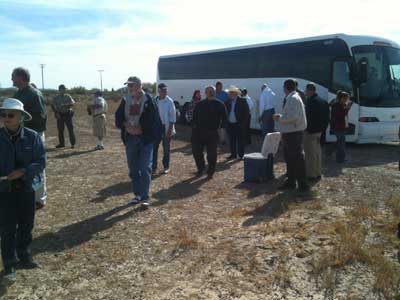
BrightSource Energy answered questions from about 100 people, some of whom came to to ride a bus which drove to the proposed project site. Afterwards, people packed the small Tecopa Community Center to listen in and give comments at the formal CEC Informational Hearing.
BrightSource gave a presentation, explaining that it is proposing a solar thermal power plant with two 750-foot tall power towers on 3,200 acres of private land, to produce 500 MW net (540 MW gross). But the power towers will not be constructed of steel lattice like Ivanpah, but of cement -- the CO2 emissions from all this cement manufacture should be calculated.
In contrast, Ivanpah Solar Electric Generating System now under construction about 20 miles to the southeast, has a larger footprint of 3,800 acres that will produce 370 MW to the grid. The power tower on Unit 1 is currently 150 feet tall and will reach 500 feet upon completion. The two plants would each have solar fields composed of 85,000 heliostats (mirror arrays).
The taller towers supposedly decrease the footprint, to "avoid" sensitive plants, such as the first known California occurrence of Nye milkvetch in the area. BrightSource claimed it was "disturbed ground" (mostly not -- creosote, honey mesquite, alkaline valley floor habitats), while at the same time CEC admitted it was "all good quality desert tortoise habitat."
The company was going to make some other changes from its Ivanpah project, including new wireless technology to communicate on the site, such as turn the mirrors to aim at the central power tower. Heliostat placement would be in fields that would not be graded completely, but native vegetation would be left in place as much as possibly.
BrightSource stated that a workforce of 1,000 plus would be needed for construction, and 100-120 workers for operation. the power plant would contribute $265 million in state and local taxes over the lifetime of the project.
CEC expected to give a decision on whether to license the project in October 2012. A Preliminary Staff Assessment would be released around March 2012, and a Final Staff Assessment by May. CEC identified the important issues as biological resources, cultural resources, water, visual impacts on the viewsheds, as well as Law enforcement, safety, and fire response time. Date requests were sent to the applicant.
Download the Valley Electric Association transmission proposal, 2.8 MB PDF >>here.
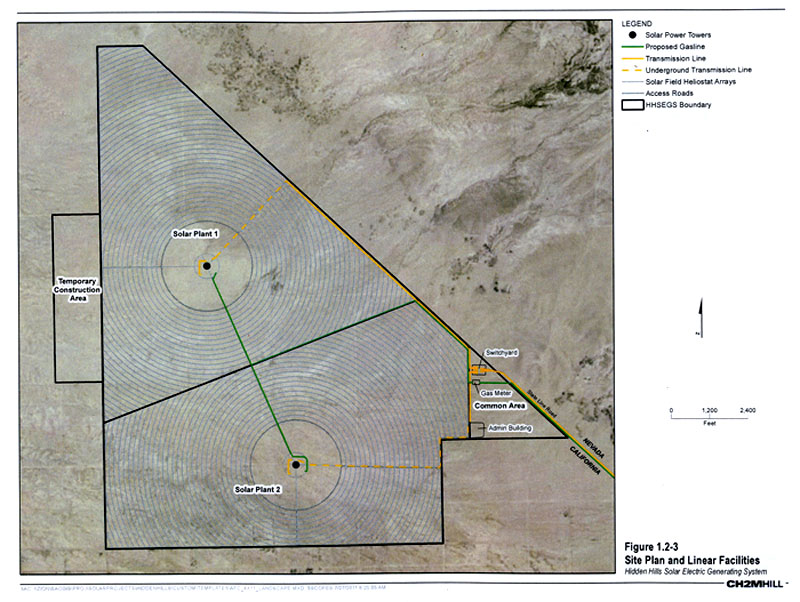
^Map of the two power towers and mirror fields.
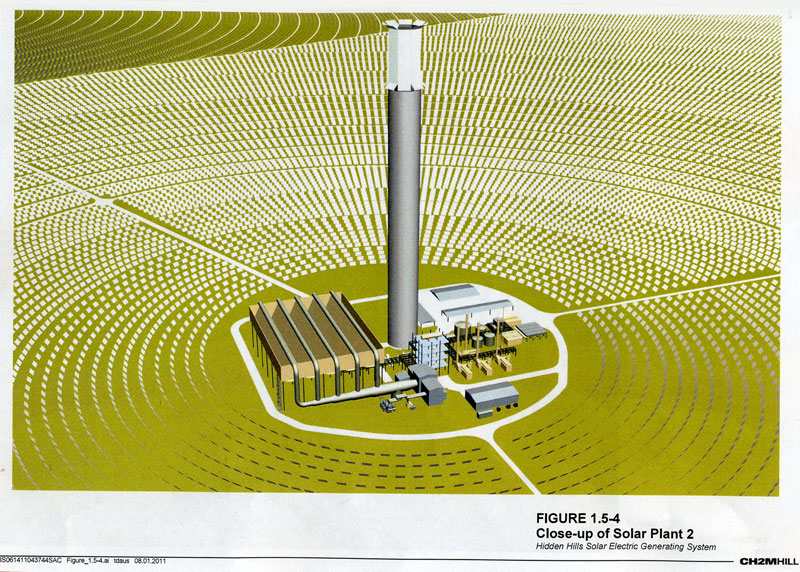
^Diagram of power plant.
Water
Water use was a big issue, residents and local conservationists concerned over groundwater pumping. BrightSource says the plant will be dry-cooled in a closed loop, so that very little water will be lost during operation. 140 acre-feet per year (afy) would be used for operation, while 288 afy would be needed each year during construction for two years. The Pahrump Valley is overdrawn, however, and dropping in subsurface water level. BrightSource has water rights secured, with three primary wells on site, and three back-up wells.
Mitigation options will be developed, and would probably include buying and retiring existing water rights, as well as other options such as educating the community about and contributing to water conservation measures.
The hydrology of the Death Valley Regional Aquifer is poorly understood so there will be some push back by water conservationists. And only 240 acre feet a year for two years for construction which is less than half the predicted for other projects of the same size.
Linears
A natural gas pipeline and new transmission line will be built along the California-Nevada state line. HHSEGS will use a natural gas boiler to burn no more than 10% natural gas on an annual basis, for morning start-up of the system and keeping the steam turbine going through passing clouds.
The transmission line would parallel Tecopa Road, then along the state line, eventually ending up at the Eldorado substation south of Las Vegas, Nevada. Valley Electric Association, the local co-op utility in Nye County would construct and own the transmission line; BrightSource would not own it. Southern California Edison would be the buyer of the power.
Jeff Harris, an attorney representing BrightSource, explained this case provides a unique project along a state boundary that has parts in two states. He said that the the Bureau of Land Management will carry out the environmental review for the transmission line, which will lie on BLM land and private land in Nevada. The HHSEGS power plant will be evaluated pursuant to the National Environmental Policy Act (NEPA) as a "connected action" to the transmission project. Valley Electric Association applied to BLM for the Right-of-Way for the linears, so in that case VEA is the applicant, HHSEGS will not own or operate the transmission line.
The BLM review of the connected action will provide the federal nexus (permit) for Section 7 consultation under the Endangered Species Act, US Army Corps of Engineers review of Waters of the US, Section 106 historical analysis, and other permits.
The power plant itself will be reviewed under the California Environmental Quality Act, with CEC as the lead agency.
Informational Hearing in Tecopa Community Center
A large audience of local residents was mostly opposed, and there was standing room only. First responders (Law Enforcement and fire) worried about remoteness. The Pahrump Paiute Tribe voiced concerned about sacred landscape.
Also present were various environmental groups: Center for Biological Diversity, California Native Plant Society, The Nature Conservancy, and Amargosa Conservancy. Inyo and Nye County commissioners were present, as were Lahontan Regional Water Quality Control Board, Great Basin Air Quality District, Southern Inyo Fire Protection District, and Valley Electric Association.
People in the audience asked about the potential mortality of birds and bats flying through these giant power tower sunrays, but BrightSource responded that bats do not come to this part of the valley, and "we will address that more later," which they did not.
Someone asked BrightSource, “How does the environmental community feel about the Ivanpah Solar Project?" BrightSource responded by saying “That’s a hard question to answer....”
Others questioned where all the electricity would go, would any remain for local use? BrightSource said presently all electricity was destined for export to California, but the company was open to future expansions and possible new transmission projects that could benefit locals.
The private land was previously slated for housing units and at other times a master-planned community proposal. One member of the audience questioned what the impact would be from so large an industrial development on any new housing that might be built nearby.
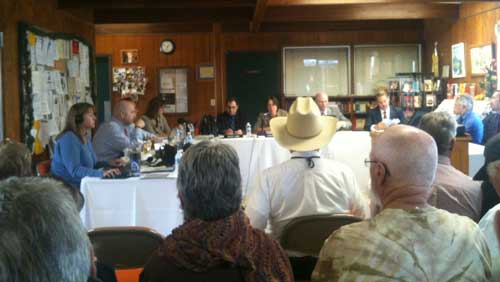
^California Energy Commission undertaking a formal Informational Hearing in the Tecopa Community Center, with BrightSource representatives and recorder on the left.
October Workshop
The workshop on October 21 concerned Air Quality and Biological Resources for Hidden Hills SEGS. California Energy Commission conducted the workshop, and is in the discovery phase of making data requests from the applicant.
Air Quality
The Air Quality concerns were brief, mostly Great Basin Unified Air Pollution Control District needs more info on a dust mitigation plan and annual metric tons of emissions of CO2 (BrightSource plans to burn a small amount of natural gas as back-up heating for the power plant).
Biological Resources
--Desert tortoises are present on the project site and a translocation plan will need to be developed. US Fish and Wildlife Service will do Section 7 consultation, and California Department of Fish and Game will work with the California Energy Commission to implement mitigation measures. BrightSource was concerned that the window for blood-testing tortoises (May-October) not conflict with moving tortoises so that construction may begin in fall 2012.
--Burrowing owls are present on the site.
--Golden eagle surveys are ongoing (helicopter and pedestrian), and a potential eagle nest has been found in the nearby Nopah Range approximately 20-30 miles away.
--Nelson bighorn sheep are present in the Nopah Range to the west of the project.
--Avian Point Counts have been done through the project site and in a buffer zone around it, and winter point counts will be done. Some sensitive species include Prairie falcon, and Phainopeplas were found nesting in mesquite just south of Tecopa Road.
--Bats caused the most issues. CEC is concerned about bat impacts by the two 750-foot power towers and new transmission line, and wants two Anabat meters (which detect bat radar clicks and can distinguish species of bats) placed on a tower for a year of pre-project surveys. One would be placed low and another high, to detect different species which fly at different heights. BrightSource said they have one Meteorological tower on site and will place an Anabat meter on top of it, but argued against more, saying their power plant will be dark at night when the bats are flying. CEC said this is new, having a glowing hot top on a 750-foot tower, that might still be hot when bats start to fly in the early evening. During operation, BrightSource will be required to carry out avian and bat mortality counts, and the pre-project data can be used for comparison and adaptive management.
Rare Plants
The Pahrump to Sandy Valley area is biologically very significant, but urban sprawl has impacted much of the area.
Rare plant baseline data was collected, and 8 sensitive species have been found in the area, although BrightSource said none are on the project site itself. The project will try to avoid all rare plants by its design: the taller power towers mean the mirror fields can be smaller. Seed collection and transplanting are also on the table as mitigation if any rare plants are impacted. BrightSource hoped the Desert Renewable Energy Conservation Plan will soon enable companies to participate in an in-lieu fee program instead of trying to find and purchase compensation lands for sensitive species if needed.
The sensitive species listed as potential include:
Utah penstemon (Penstemon utahensis)
Ash meadows buckwheat (Eriogonum contiguum)
Pahrump buckwheat -- (Eriogonum bifurcatum) very close to project site, just to south
Johnson beehive cactus (Sclerocactus johnsonii) - to the west
Also mentioned were a grama grass (Bouteloua trifida), a needlegrass (Stipa arida), Tidestrom's milkvetch (Astragalus tidestromii), and mesquite bosques to the west (although we saw occasional Honey mesquite - Prosopis glandulosa - all around and in the project area). But botanists familiar with the area say dozens more sensitive plants are or may be in the area, and further surveys will be needed.
The first California occurrence of Nye milkvetch (Astragalus nyensis) was announced from surveys. This species grows on subsaline sandy soils that can be inherently shifting substrates. Nearby ranches and ranchettes and urban sprawl have rapidly spread into it's critical habitat over the past few decades, and this is some of the last remaining habitat for the plant.
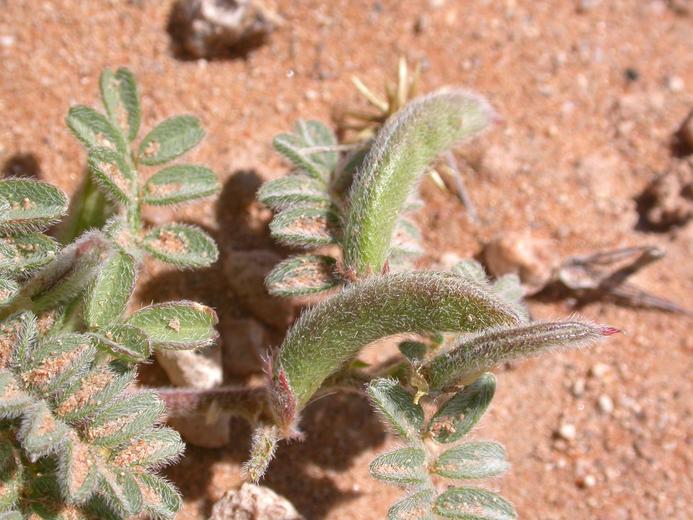
^Nye milkvetch. (Photo © 2005 James M. Andre, used with permission. http://calphotos.berkeley.edu/cgi/img_query?enlarge=0000+0000+0105+2214)
Surface Waters
US Army Corps is making a determination on Waters of the US, but there may be two washes that qualify, each about 4 feet deep. State jurisdictional waters are also present, and Cal DFG would regulate jurisdiction over ephemeral washes that have species using flood waters or plant species used as food or cover on the banks -- DFG would implement a mitigation ratio for land compensation of similar value.
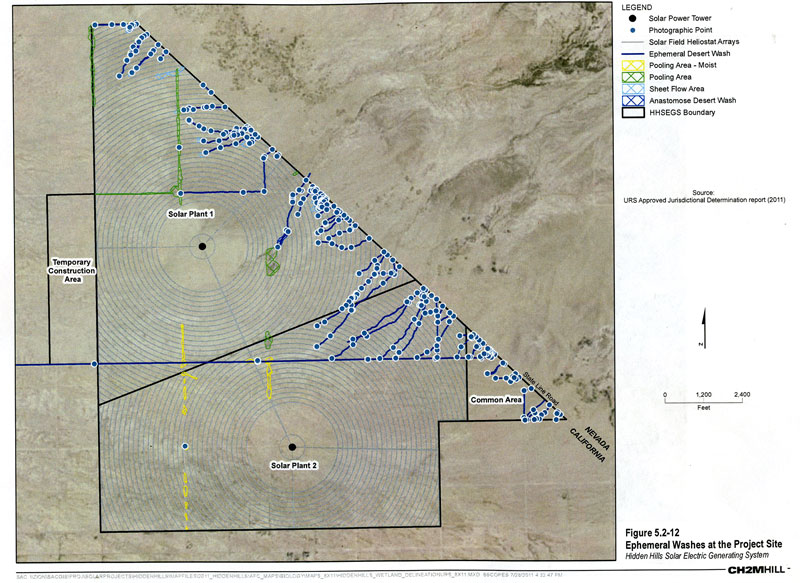
^Ephemeral washes and alkaline pool habitat on the project site.
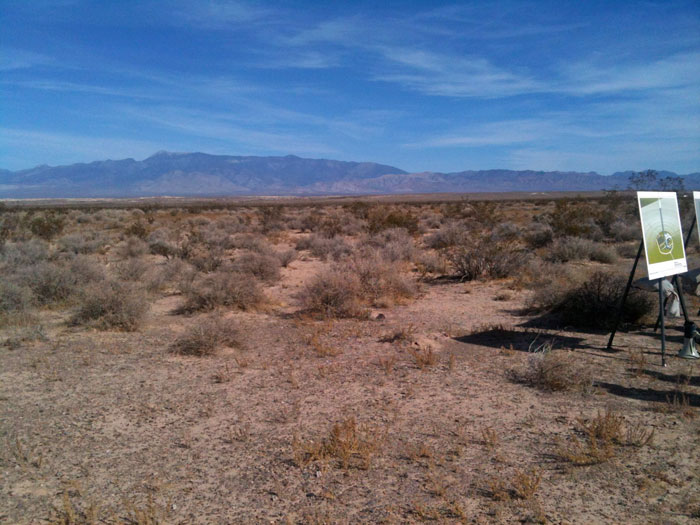
^Maps set up on the proposed project site for public viewing.
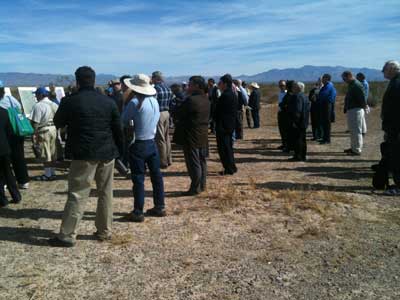
^Site visit with the public.
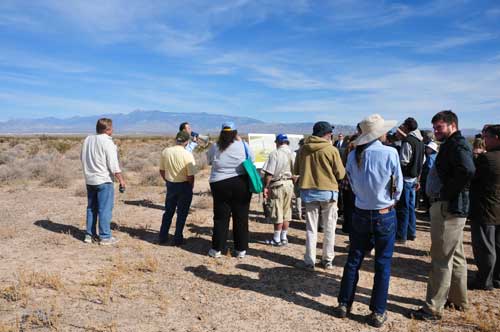
^Site visit.
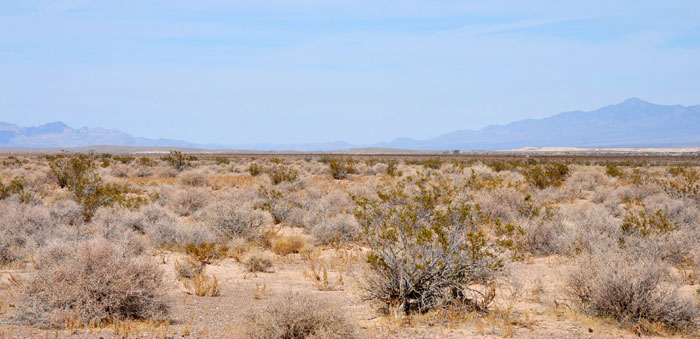
^Much of the project site appeared to be creosote-bursage Mojave desert scrub.
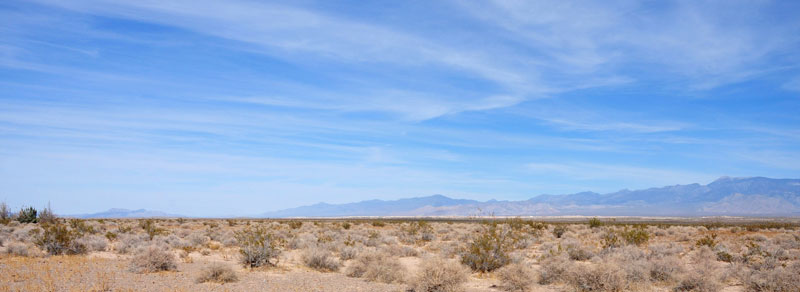
^Panorama of the proposed project site with the Spring Range in the distance.
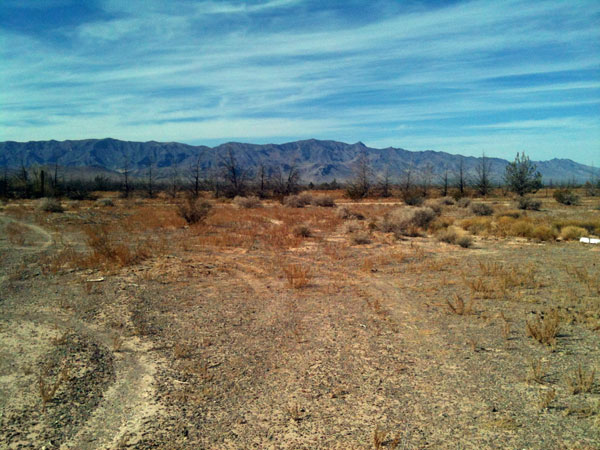
^The site visit bus tour parked on an old orchard that would be a part of the project next to the road.
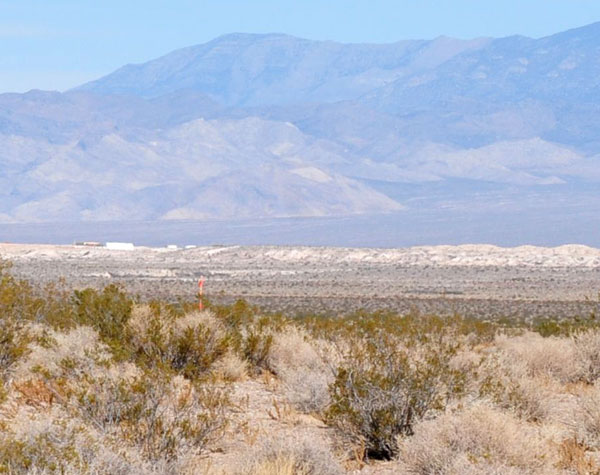
^Orange survey marker placed in the desert to mark the position of one of the proposed 750-foot tall power towers.
New Transmission Line Proposed
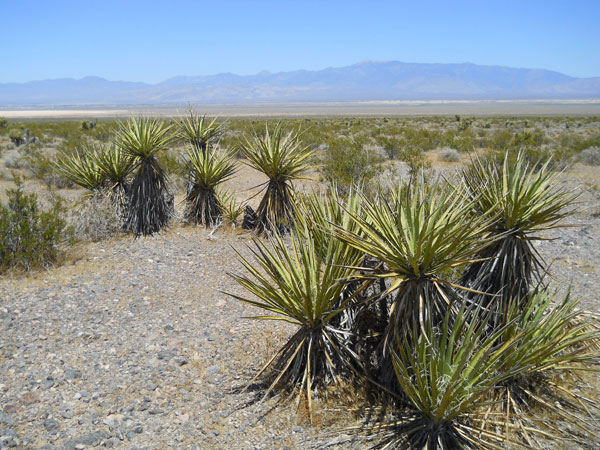
^Mojave yuccas (Yucca schidigera) above and to the west of the proposed Hidden Hills Solar Electric Generating System site, showing the valley beyond in Nevada where the proposed new transmission line would be built. The Spring Mountains loom in the distance.
October 11, 2011 - The co-op utility Valley Electric Association is seeking to build a new transmission line to serve the proposed Hidden Hills Solar Electric Generating System project on private land in Inyo County, California. The new line would cross Bureau of Land Management areas in Nevada, and thus be up for a public environmental review process under the National Environmental Policy Act. Comments are due December 12, 2011.
Announcement in the Federal Register: Bureau of Land Management
Notice of Intent To Prepare an Environmental Impact Statement for
the Proposed Valley Electric Association Hidden Hills Transmission
Project, Clark and Nye Counties, NV
ACTION: Notice of Intent.
-----------------------------------------------------------------------
SUMMARY: In compliance with the National Environmental Policy Act of 1969, as amended, and the Federal Land Policy and Management Act of 1976, as amended, the Bureau of Land Management (BLM) Southern Nevada District, Las Vegas Field Office, intends to prepare an Environmental Impact Statement (EIS) and by this notice is announcing the beginning of the scoping process to solicit public comments and identify issues.
DATES: This notice initiates the public scoping process for the EIS. Comments on issues may be submitted in writing until December 12, 2011. The date(s) and location(s) of any scoping meetings will be announced at least 15 days in advance through local news media, newspapers, and the BLM Web site at: http://www.blm.gov/nv/st/en/fo/lvfo.html. Comments must be received prior to the close of the scoping period or 15 days after the last public meeting, whichever is later, to be included in the Draft EIS. We will provide additional opportunities for public participation upon publication of the Draft EIS.
ADDRESSES: You may submit comments related to the Valley Electric Association Hidden Hills Transmission Project by any of the following methods:
E-mail: ValleyElec_HiddenHillsEIS@blm.gov.
Fax: (702) 515-5010 (attention: Gregory Helseth).
Mail: Gregory Helseth, BLM Southern Nevada District Office, 4701 North Torrey Pines Drive, Las Vegas, Nevada 89130-2301.
In Person: At any EIS public scoping meeting.
Documents pertinent to this proposal may be examined at the BLM Southern Nevada District Office.
FOR FURTHER INFORMATION CONTACT: Gregory Helseth, Renewable Energy Project Manager, (702) 515-5173; or e-mail ValleyElec_HiddenHillsEIS@blm.gov. You may also use this contact information to request that your name be added to the project mailing list. Persons who use a telecommunications device for the deaf (TDD) may call the
Federal Information Relay Service (FIRS) at (800) 877-8339 to contact the above individual during normal business hours. The FIRS is available 24 hours a day, 7 days a week, to leave a message or question with the above individual. You will receive a reply during normal business hours.
SUPPLEMENTARY INFORMATION: The applicant, Valley Electric Association (VEA), has requested a right-of-way authorization for the construction, operation, maintenance, and termination of transmission infrastructure improvements in Pahrump and Sandy Valleys to Jean, Nevada, and terminating at Eldorado Substation near McCullough Pass. The proposed project will support the delivery of 500 megawatts into the VEA transmission system through the development of a solar electric generating facility to be located on private land in Inyo County, California. The proposed improvements may also support the development of additional renewable resource generation facilities in Nevada.
The proposed transmission upgrades would consist of the following new or expanded facilities on BLM managed land: A new 10-acre Tap 230/500 kilovolt (kV) Substation (Tap
Substation) located immediately northeast of the existing VEA 138 kV and VEA 230 kV transmission line alignments adjacent to Highway 160. Approximately 53.7 miles of new 500 kV single-circuit transmission line from the Tap Substation to the existing Eldorado
Substation. Approximately 9.7 miles of new 230 kV single-circuit transmission line from the solar electric generating facility site in Inyo County, California to the new Tap Substation.
Improvement of existing VEA facilities to accommodate the necessary interconnections at Pahrump Substation, Vista Substation, Gamebird Substation, Charleston Substation, and Eldorado Substation.
Installation of a buried 9.3 mile, 12-inch natural gas pipeline, which would extend from the solar electric generating facility site in Inyo County, California, to the existing VEA 230 kV transmission line. From this location, a 36-inch line would turn southeast and continue 26 miles to where it intersects the existing Kern River Gas Transmission pipeline. Construction and operation of new and improved existing access roads along each of the proposed transmission alignments. Temporary work areas associated with construction
activities, material storage, and staging. The proposed transmission project is in conformance with the 1998 Las Vegas Resource Management Plan and does not require a land use plan amendment.
The purpose of the public scoping process is to ascertain the relevant issues that will influence the scope of the environmental analysis, including alternatives, and guide the process for developing the EIS. At present, the BLM has identified the following preliminary issues: threatened and endangered species, visual resource impacts
(including visual effects to the Old Spanish Trail National Historic Trail), recreation impacts, socioeconomic effects, and connected and cumulative actions.
The BLM will utilize and coordinate the NEPA commenting process to satisfy the public involvement process for Section 106 of the National Historic Preservation Act (NHPA) (16 U.S.C. 470f) as provided for in 36 CFR 800.2(d)(3). Native American tribal consultations will be conducted in accordance with policy, and tribal concerns will be given due
consideration, including impacts on Indian trust assets. Federal, State, and local agencies, as well as individuals, organizations, or tribes that may be interested or affected by the BLM's decision on this project are invited to participate in the scoping process and, if
eligible, may request or be requested by the BLM to participate as a cooperating agency.
Before including your address, phone number, e-mail address, or other personal identifying information in your comment, you should be aware that your entire comment--including your personal identifying information--may be made publicly available at any time. While you can ask us in your comment to withhold your personal identifying
information from public review, we cannot guarantee that we will be able to do so.
Mary Jo Rugwell,
District Manager, Southern Nevada District Office.
http://www.gpo.gov/fdsys/pkg/FR-2011-10-11/html/2011-26192.htm
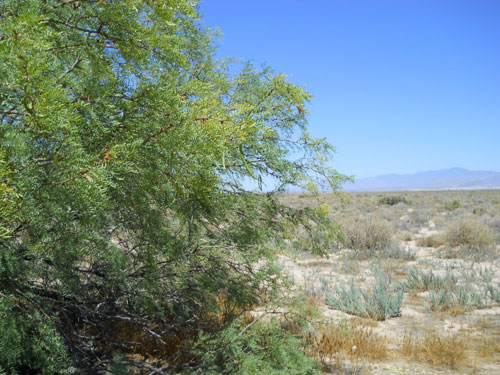
^Honey mesquite (Prosopis glandulosa) on the project site of the solar power plant.
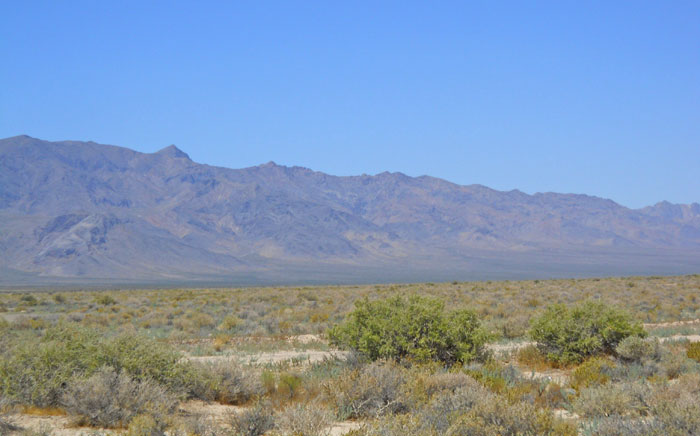
^Solar plant project site with wolfberry bushes (Lycium sp.) and alkaline shrublands and ephemeral pools. Spring Mountains in the distance.
Inyo County Keeps Hidden Hills Project But Drops Renewable Energy Plan Amendment
September 8, 2011 - Pressure by Center for Biological Diversity and Sierra Club in a lawsuit alters Inyo County's General Management Plan renewable energy zone amendment >>here.
Project Application Enters California Energy Commission
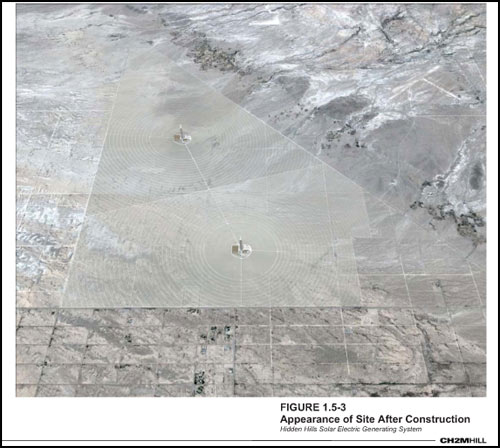
^Simulation of the two power towers of Hidden Hills SEGS.
August 5, 2011 -The proposed project site is in Mojave Desert scrub on an alluvial fan, with desert tortoises, burrowing owls, badgers, rare plants, and is surrounded by Wilderness Areas. The project will need a new transmission line that will go through Bureau of Land Management desert, through Sandy Valley to the natural gas power plant near Primm, Nevada. That separate environmental review will apparently be initiated in September 2011.
From the California Energy Commission website - http://www.energy.ca.gov/sitingcases/hiddenhills/index.html:
General Description Of Project
The Hidden Hills Solar Electric Generating System (HHSEGS) is being developed by Hidden Hills Solar I, LLC, and Hidden Hills Solar II, LLC (the Applicant), wholly owned subsidiaries of Hidden Hills Solar Holdings, LLC, (their sole member) which is in turn a wholly owned subsidiary of BrightSource Energy, Inc. (BrightSource) (its sole member), a Delaware corporation.
HHSEGS will be located on approximately 3,277 acres (5.12 square miles) of privately owned land in Inyo County, California, adjacent to the Nevada border. The project site is approximately 18 miles south of Pahrump, Nevada, and approximately 45 miles west of Las Vegas, Nevada.
HHSEGS will comprise two solar fields and associated facilities: the northern solar plant (Solar Plant 1) and the southern solar plant (Solar Plant 2). Each solar plant will generate 270 megawatts (MW) gross (250 MW net), for a total net output of 500 MW. Solar Plant 1 will occupy approximately 1,483 acres (or 2.3 square miles), and Solar Plant 2 will occupy approximately 1,510 acres (or 2.4 square miles). A 103 acre common area will be established on the southeastern corner of the site to accommodate an administration, warehouse, and maintenance complex, and an onsite switchyard. A temporary construction laydown and parking area on the west side of the site will occupy approximately 180 acres.
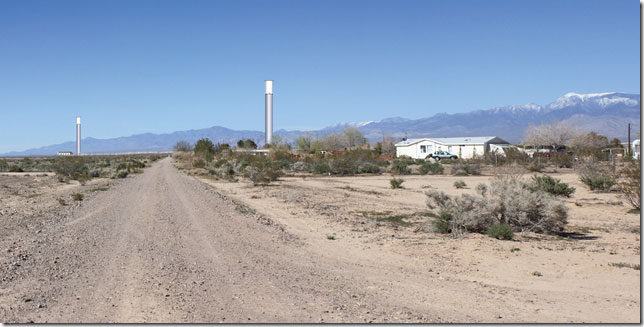
Each solar plant will use heliostats - elevated mirrors - guided by a tracking system mounted on a pylon to focus the suns rays on a solar receiver steam generator (SRSG) atop a solar power tower near the center of each solar field. The solar power tower technology for the HHSEGS project design incorporates an important technology advancement, the 750-foot-tall solar power tower. One principle advantage of the HHSEGS solar power tower design is that it results in more efficient land use and greater power generation. The new, higher, 750 foot solar power tower allows the heliostat rows to be placed closer together, with the mirrors at a steeper angle. This substantially reduces mirror shading and allows more heliostats to be placed per acre. More megawatts can be generated per acre and the design is more efficient overall.
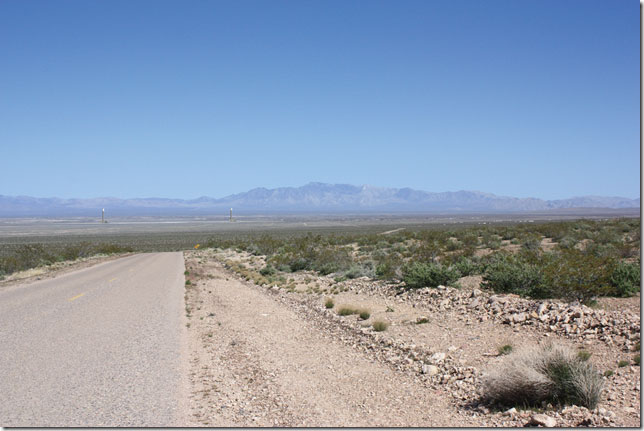
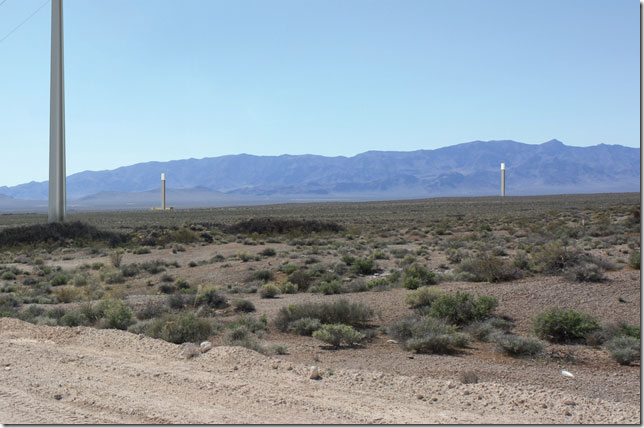
Visual simulations of the project, from the Application for Certification:
BrightSource Plans Power Tower in Mesquite Valley, CA
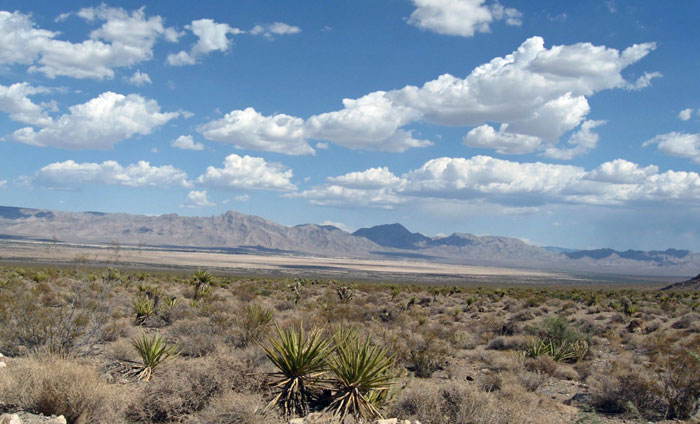
^A view of Mesquite Valley south of the proposed solar project area, looking at Mesquite Dry Lake.
January 12, 2011 - The solar company currently building the Ivanpah Solar Electric Generating System power tower project to the south in California wants to construct the Hidden Hills Ranch Solar Electric Generation Station, which would be located on 3,157 acres of private land in Inyo County along the Nevada border. The project is along the Tecopa turnoff in Pahrump-Mesquite Valley.
Inyo County granted a conditional use permit on December 1 for a temporary weather monitoring station on 20 acres at the northwest corner of Silver Street and Avenue D in Charleston View, a mile north of the Tecopa Turnoff, for six months. It will consist of an eight-foot tall weather station to evaluate whether the site is viable for solar energy production.
BrightSource would still have to take its application through the California Energy Commission, which licenses all thermal power plants on public and private land.
The area is excellent tortoise habitat in Mojave Desert scrub, and would be within view of the Kingston and Nopah Ranges.
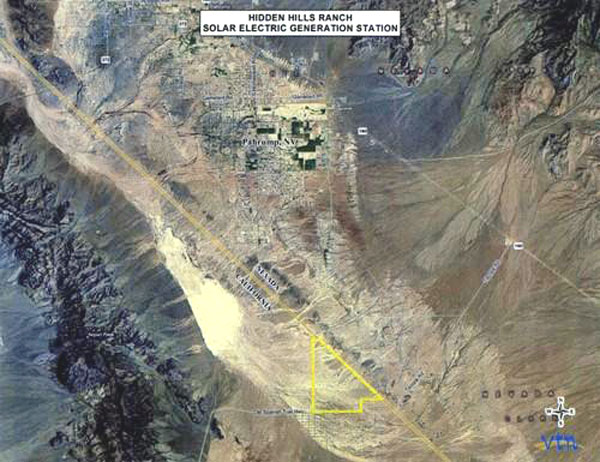
Story in Pahrump Valley Times:
http://pvtimes.com/news/solar-energy-project-planned-across-state-line/
HOME.....ISEGS.....Sandy Valley Alternative Site
